Search This Blog

Badger

Badger
In Greenland

Iron Bark

Iron Bark
Under full sail

Fantail

Fantail
At Russell Boating Club's Tall Ships Regatta

Blue Water Medal

Blue Water Medal
Blue Water Medal

Books By Annie Hill

  • Brazil and Beyond
  • Voyaging on a Small Income

15 July, 2013

It was the end of January before I'd finished my refit, and I was spurred on to leave by the thought of going to the Mahurangi Traditional Boat Regatta.  Now a Raven 26, even one that's over 25 years old (and therefore, so I'm told, a 'Classic' Boat) could not by the wildest stretch of the imagination be described as a traditional boat, which meant that we couldn't enter.  However, as I am not keen on racing at the best of times and would hate to race my own boat, this was far from being a drawback.  So I decided to go as a spectator.

We had a fine sail down past Kawau Island and into Mahurangi Harbour, where we anchored amidst the fleet, not far away from Gary and Beryl Underwood's recently restored Mason Bay.  I ended up joining in the racing and with junk rig - when David Thatcher kindly invited me to sail on Footprints.  We seemed to have far less drama in the gusty conditions, than those on the gaff and bermudian-rigged boats.  Gaff rig is undoubtedly beautiful, but I will stick with junks, thank you very much.

We had a wild sail back to Whangarei, with a very fresh easterly that had us averaging well over 6 knots: including three hours of tacking, we sailed the 57 miles in 11 hours.  Fantail can pick up her heels when she wants to.  I drove the boat quite hard - normally I'd have put more reefs in - to give the rig a proper trial.  I have made a new yard, this time out of Douglas Fir, and was pleased to see that it gave no problems.

This was the last time that I had to sail in more wind than I'd ideally choose, all summer, because from then on we had the most glorious weather and predominantly easterly winds.  I spent quite a bit of time ambling around and exploring the Hauraki Gulf.  I attended a wonderful RCC Meet in Waiheke, where we pottered around to various anchorages and had some interesting visits ashore.  Fortunately, the distances were short, because we had very little wind.  Mike Robinson took some lovely photographs of Fantail.


From Waiheke I went junk hunting, meeting up with friends in Tamaki and Herald Island, who were busy getting their boats ready for launching.  Shoestring had been well and truly neaped many moons ago and it was looking unlikely that she would get off the mud in order to meet up with some other junkies in a few weeks time.  Fortunately, with a lot of effort, and a little luck, Roger got her back afloat and we met again off Waiheke, to have a little junket.  Arcadian also joined us, as did Pugwash - all 7ft 8ins of her.

 
 We didn't get much sailing done - again, there was hardly any wind, but had a fine social time of it.  It was fun to see such unusual boats together:


Shoestring sailed back to Herald Island and Pugwash went off on her car back north.  Arcadian and Fantail had to dodge a nasty blow for a day or so, but we had a splendid sail back to Whangarei, with Fantail giving the much larger Arcadian a good run for her money for a while.


Sadly, for David and Rosemary, this would be their last good sail: David has a heart problem and long-distance sailing is no longer feasible.  Arcadian is now on the market and looking for a good home.

Another boat that we missed at this year's junket, was Pacific Spray:


her owners were in Germany.  Pacific Spray is also for sale, (http://www.apolloduck.com/feature.phtml?id=304587), but for happier reasons: Rob and Maren are planning to downsize and build one of Gary Underwood's Shoehorn designs: a 26 ft version of Shoestring.  This is a boat that I find very attractive, and I'm very much looking forward to seeing her under construction.  She will, of course, have a junk rig. (http://gary-underwood-designz.co.nz).

The final highlight of this wonderful summer, was seeing the re-launch of Paul Thompson's La Chica.


Paul has spent over 7 years completely rebuilding the 32ft Tahitiana and plans a non-stop circumnavigation, to start in 2014.  He is completely deaf and is hoping to raise awareness about cochlear implants (www.sailingwithoutasound.com).  The boat is now sailing - I went along for the maiden voyage - and her teal-coloured junk rig looks quite magnificent.   


(Sorry about the small size of the photo - I filched it from the Junk Rig Associations Photogallery (http://www.junkrigassociation.org/photo_gallery).


Refitting and Upgrading 'Fantail'

I can't believe how long it is since I put anything on this blog!  The trouble is that I want to do it right - so because there always seems to be something else to do, I don't do it at all.  I have a draft here, that goes back months and I've decided that today's project is to bring it to a hasty conclusion and get it posted!!!

I had intended to haul Fantail out of the water in October, to do a quick antifoul.  At the same time I would build the new yard.  But life, as so often happens, got in the way and I ended up spending 7 weeks looking after a friend recovering from a couple of operations.  Most people would have been delighted to live in a beautiful house, surrounded by lovely bush, on a beach in the Bay of Islands.  There were projects to do, a garden to play in and a fine kitchen where I could spread my wings and cook to my heart's delight.  But I have to say that by the time I went back to Fantail I was more than ever convinced that I am meant to live on a boat and will only be happy as long as I'm living in this way.

By now my poor little ship was supporting the makings of a marine reserve, and there was now no debate about putting off the haulout any longer.  I had intended to go to Norsand in Whangarei, but they only had a few cradles small enough for my boat (!), so I ended up going to Riverside Marine, just downstream from the Town Basin.  This proved to be a good choice and they looked after me well.  But, as is increasingly the case, I was penalised for having a small boat.  This trend is becoming depressingly common.  While at first glance, it might seem fair for an 8-metre boat to be charged half of what a 16-metre boat pays, in fact it is far from just.  An 8-metre boat requires only 21 square metres of water, while her 16-metre long sister will need 85 square metres.  And that is only a part of the unfairness:  the larger boat will need a deeper berth - perhaps artificially dredged - a much larger turning area and more substantially moored pontoons with larger cleats.  And this overlooks the fact that it's not unfair to assume that the larger boat will probably be worth ten times as much as her little sister, so that the cost of mooring the boat will be a much smaller part of her general maintenance costs.  I find it sad, and indeed potentially rather stupid, that small boats are being discriminated against: many people start sailing when they are young and impecunious, only to gradually buy larger and more expensive vessels as their disposable income increases.  If these people had been unable to afford to moor their boats in the first place, then they might have decided to take up another sport instead.  And where would the yards and marinas be then?

It was explained to me that the reason that I was charged a minimum of 10 metres, is because the travel lift needs a certain amount of room to move and that this limits the number of boats that can be fitted in the yard.  Fair enough.  But why was I charged at the 10-metre rate for scrubbing off, for chocking up, etc, etc.  And why a minimum of 10 metres in an alongside berth?  But that was generous compared with the Town Basin, who insist that I pay as a 12-metre yacht if I wish to go alongside.  And I'm not talking about individual slips, here - I am talking about mooring alongside.  But I would bet that I wouldn't be allocated my full 12 metres of dock space if a further boat could be squeezed in!!  And this marina is run by a non-profit trust.  So why are small boats required to subsidise larger ones?

However, I didn't have much choice, so I bit the bullet, hauled out and set to work. There were a few bumps in the antifouling, which may, or may not, have been osmosis.  Supposedly the boat has been treated for osmosis in the past, but I've no idea whether it was professionally, or even competently, carried out.  I knocked the top off them all and only 2 or 3 showed signs of weeping.  I decided that as I'd be leaving the antifouling until the final job, I'd let these spots dry out and see what they looked like in a couple of weeks.

I had never had the chance to finish repainting the deck, so that was the first job.


When I had first bought Joshua, as she then was, there had been a considerable amount of maroon trim, which I disliked.  It had taken ages to get rid of the stripes on the white topsides, and the maroon paint all over the deck wasn't much easier to remove.  A heat gun seemed to be too savage because it lifted the gelcoat beneath, as well as the paint, which I found rather surprising.  In the end I resorted to paint stripper and various scrapers, followed by vigorous wet sanding.

Another job that I wanted to do was to varnish all the teak.  Fantail has a teak capping along the edge of the deck and I don't think this had ever been varnished.  I am not a fan of the so-called 'scrubbed teak' look, which actually means neglected, weathered, grey wood.  Teak can tolerate an enormous amount of neglect and still scrape up easily to a beautiful colour, but like all wood, if left completely unprotected, it will weather, and get damaged.  I was delighted with Fantail's paint scheme, but the grey teak disappeared into the alloy toe rail (not the prettiest thing in the world) and I felt that brightly varnished teak would enhance her appearance.  I had been told about a Kiwi product called 'Uroxsys' and decided to try this out.  The product consists of a clear primer and a clear topcoat.  You prepare the wood and put on one coat of primer.  Then you put on at least 6 coats of the second part.  This is a regime I would follow anyway, the primer being the equivalent of thinned varnish - although I'd usually put 2 or 3 coats of this on, with progressively less thinners in each coat.  Uroxsys has several advantages over the competition.  It is easier to use than two-part polyurethane - its closest competitor, because it doesn't need mixing.  It is more flexible, but like most two-part polyurethane 'varnishes', it is perfectly clear.  Because it is clear, you don't need to mask off or work super-carefully like you do with conventional varnish.  It is supposedly much longer lasting than conventional varnish.  Its clarity makes it a much more attractive finish that the stained finishes designed for doors and windows in houses, that so many people use nowadays.  You can apply another coat as soon as the previous one is touch dry, which means that the whole varnish job can be carried out more rapidly.  It is far too soon to judge its longevity, but even if it only lasts as long as top-quality spar varnish, I'd go for it again, if only for the ease of application.  It's not much more expensive than a brand-name spar varnish.  So, before I painted, I scraped and sanded the wee bit of teak that support the aluminium toerail along the deck.

I then sanded all the rest of the deck forward of the cockpit canopy and applied 3 coats of Altex primer.  On top of this I applied Altex two-pack polyurethane, finishing off with their non-skid compound.  This latter proved to be a serious disappointment, because in spite of following the directions to the letter, the result was very uneven leaving some areas of the deck slippery and others excessively rough.  And of course, the appearance was also disappointing.


But it was a lot better than it had been!

I hate washboards and Fantail had three of the things.  Why do I dislike them?  Well, for a start, there is never a proper place for them, in reach of the hatch so that you can drop them in at a moment's notice if it suddenly comes on to rain; and even if they do have a proper home, they rattle around and get in the way until they are stowed.  If you are sailing in the rain, particularly with a following wind, you are constantly taking them in and out as you go below to check the chart, make a cuppa, etc and again, they are a damn nuisance to put down while you climb in and out.  And they have an annoying tendency always to fall over with an awful clatter, if you prop them up 'for a moment' and I dislike sudden, loud noises!  So all in all, washboards and I do not get on.

F


For some time, I had been thinking of the idea of a fold-down companionway, to get rid of this problem.  Most people I'd mentioned it to, had shaken their heads dubiously and sucked their teeth pessimistically.  It's the sort of "what-was-good-enough-for-me,-my-father-and-his-father-before-him,-should-be-good-enough-for-a-foolish-woman" attitude that I am used to, but still a bit discouraging for all that.  However, I threw the idea out to my wonderful friends in the junk rig community (www.junkrigassociation.org) and someone in Queensland promptly came back with photographs of his companionway, which was very similar to what I was planning.  Admittedly, Arion has a sliding hatch and I have none.  On the other hand, I am a hobbit and this boat is being altered to suit me, not some putative buyer in the dim and distant future.  Anyway, armed with the knowledge that a least one other person had used 'my' idea and was happy with it, I bent what is laughingly-called my mind to the problem of creating it.

And now I'm going to cut a very long story, very short by simply putting a few pictures here so you can see for yourself what I did:

Preparing the cockpit sole for the new bulkhead

Making the pattern

Fitting the new bulkhead

Making a pattern for the locker lid, on which the new hatches rest.  See also that part of the lower washboard has been cut and glued in, in order to provide a sill.

Adding the framework on which the hatch boards will land.

Gluing in the additional framing

The completed 'washboards'/hatch  
There now, that was nice and fast, wasn't it?  The extra locker provided by the new bridgedeck is a perfect place for a bilge pump (which, until then, I'd never found a home for) and I can also keep some collapsible water containers there, ready to take ashore.

I'm sure that you are awe-struck at my standard of woodwork, but I have to confess that most of the teak was fitted by a real boatbuilder.  I know my limitations and I know when to pay money to people who can do things much better than I!

As well as this job, I painted the hull with two part polyurethane and also repainted the decks and cockpit.  My little ship looks a lot smarter than she did.

I was very pleased with her when we came to re-launch :


and the care that Carl and his merry men took to keep my new paint in pristine condition made me feel that other people appreciated how much work I'd put in, too:


Another thing I'd invested in was a really nice self-adhesive name.  Being a thrifty soul, I attached it to some black acrylic and screwed that to the stern, so that I can take it off next time I paint the boat.


Back in the water,it was time to get on with the cockpit paint and finish the job, all of which - as ever - took longer than anticipated.  To add insult to injury, the only rain that fell in January, came on the day I put on the final coat of paint.  Still, it looks fine from a few feet away!

A few weeks later, Mark and Phil on Icebreaker took a photo of us sailing near Waiheke Island, and I could see what the new paint job looked like.  I was pleased with it.


31 March, 2013

One or two people have left comments on my blog asking that I come back to them.  For some reason, the end of such comments is often lopped off by Blogspot.  So if you want me to reply, I suggest you open your comment with  your email address.  I do try to respond to most comments that as for feedback.  But I don't check them that often, so please be patient :-)

24 December, 2012

I know there are some comments that need answering but I've been sooo busy upgrading Fantail.  I'll get on to it in the New Year.  In the meantime, have a


30 October, 2012

I am, generally, proud of this little country at the bottom of the globe.  I am immensely proud of the fact that so many Kiwis have tried to make up for the appalling environmental ignorance and vandalism of their predecessors.  Many thousands of people give generously of their time and money, to restore populations of endangered birds and to protect other species from the predators, so foolishly introduced.  In the past our Government have helped in this, setting aside vast tracts of land for conservation.

However the present Government seems to have no interest in anything but making money.  Not only does it want to mine coal (lignite at that!) on conservation land, it recently voted against doing anything more to help save our delightful Maui's dolphin from extinction.  These dolphin are unique to N Island, New Zealand and the threat is both unnecessary and, of course, man-made.  They have a cousin in S Island. Hector's dolphin, a cheerful and confiding little animal that bustles over to spend time with a yacht in its area, puffing and diving companionably, even when you sit at anchor:


Even the Hector's dolphin is hardly flourishing, but its poor cousin is now down to probably no more than 55 males and more are dying every year.  In nets.


I have personally written to members of the Government several times about this issue, but have only ever received an automatic reply. Our Prime Minister is also Minister of Tourism.  NZ sells itself on its 'clean, green' image.  You'd think that if nothing else, the fact that we might be the first country since China (see my earlier blog) to allow a cetacean to become extinct, would give him cause to think.  Apparently not.  If, after reading this, you feel as I do, please drop him a line and ask him to get his act together: J.Key@ministers.govt.nz

Maui’s dolphin is listed as critically endangered and the Government itself identified that 95% of the threat of Maui’s dolphin mortalities comes from fishing-related death, namely entanglement in nets (including set nets and trawl nets). Mining and oil activities, pollution, vessel traffic and disease constitute the remainder of the threat, on a much lower scale but still significant given the precarious state of the population.

Since the recent, alarming, population estimate there have been further deaths of Maui’s and/or Hector’s dolphins – including entanglement in fishing gear, and dead dolphins found outside the area previously protected. Reporting of dolphin deaths in fishing nets, with or without observers onboard, indicates that only around 1% of these deaths go reported. In other words, these may represent just the tip of the iceberg.

The International Whaling Commission's scientific committee, at its 2012 meeting, noted that bycatch in gillnet and trawl fisheries is the most serious threat to these dolphins, and recommended “the immediate implementation of the proposal by the New Zealand Ministry for Primary Industries to extend the North Island protected area ..."

In September, a similar statement was made at World Conservation Congress of the International Union for the Conservation of Nature. In a vote, the IUCN passed an almost unanimous motion urging New Zealand  urgently to protect Maui’s dolphin.  There were 576 country and NGO votes in favour of the motion, and two votes against it. Each country member has two votes, and the two "no" votes belonged to New Zealand.  Can you believe it?  This country, that depends on green tourism voted against 576 other countires and organisations who wanted to protect our own dolphin!  It's beyond madness.

New Zealand  has brought species like the black robin and the kakapo back from the brink of extinction and is rightly proud of these efforts.  And yet now we are complacently contemplating the extinction of yet another unique species.  It's incomprehensible. 

I still mourn the Yangtze River Dolphin, an animal I never encountered.  Having shared the sea with the lovely little Hector's dolphin, I feel incredibly close to their cousins from N Island.  I can't bear the thought of their disappearing for no reason apart from apathy and ignorance.

If you want to know more about it, just Google Maui's dolphin.  You will find no shortage of information to bear out my story.

22 October, 2012


Although my life is now firmly based in NZ, living aboard and sailing Fantail, May and June of this year saw me back in the Maritimes and sailing on Iron Bark once again.  Trevor had invited me to join him for a couple of months, and as he was planning to winter-over once again in Greenland, I thought he might appreciate some help with the preparations.

After spending two or three weeks in Halifax, we had knocked over most of what was needed to be done, so set  off for a short cruise to the S Coast of Newfoundland, a place I have visited only too briefly in the past. We made our way up the coast of Nova Scotia, through the Bras D'Or Lakes, locking in at St Peters

In the St Peters Canal

 and on up through the Lakes, stopping once or twice on the way.

Passing under the Barra Strait Bridge
After passing through the Barra Straits, we sailed onto Baddeck, where we stayed for a few days enjoying meeting old friends again.  Then we sailed out across the Cabot Strait in bright sunshine, which ended as we approached the Newfoundland, shrouded in fog, as one expects.
  
Newfoundland fog - much less than usual this year


 However, what we didn't realise, as we groped our way in to anchor, was that for most of the rest of our stay in Newfoundland, we would enjoy beautiful, sunny weather.

Our first anchorage on the S Coast was Culotte Cove, a place Trevor had discovered the previous year and wanted to visit again.  It was a delightful spot and we had some pleasant walks ashore.
 

Iron Bark at Culotte Cove
 I must be getting old: the first few weeks in the Maritimes I found I was cold all the time.  I had just come from late autumn in New Zealand, but it was considerably warmer than late spring in the Maritimes.  Ashore, out of the wind and in the sun, I could warm up, but on the water I felt completely chilled.  On the other hand, surrounded by sea at 3 degrees, maybe I did have some excuse!

Water Temperature on 29th May!

 We sailed on to nearby Burgeo, where we went to an excellent concert, with Jim Dorie from Pictou and Burgeo's own John Coffer, whose music I enjoyed so much that I treated myself to a CD.  Burgeo has a wonderful sense of community and Trevor seemed to know a lot of people from having been there the previous year.  He had stayed for quite a while and, because he was alone, got to meet many people and enjoy much hospitality.

We left Burgeo for pretty little Doctors Harbour where we stayed for the night before heading off to Grey River.  Grey River is the start of the astonishingly dramatic scenery that brings sailors back time and again to the S Coast.  This is also the only part of Newfoundland where some of the communities still have no road access.  Sadly, there is a lot of pressure on the inhabitants of these remote communities to finish the job that Joey Smallwood started half a century ago - and move from the outports to the larger towns.  Some people have stuck to their guns and refuse to leave and Grey River is one of these communities.  The entrance to Grey River is narrow and between very high cliffs

Entrance to Grey River

and the village is squeezed onto a narrow ledge of flat land at the base to the left-hand cliff as you enter.  We went to anchor in SW Harbour, where a lot more houses had been built since our last visit.  Apparently the good citizens of Grey River (Pop fewer than 200), find there is too much hustle and bustle in the big city and need to escape to the peace and quiet of the country!  As we sailed along the S Coast, we found a lot of new building going on, which while no doubt great for the locals, was a bit disappointing for us.  This startling increase in wealth is due to the fact that many Newfoundlanders work away from the province at the Tar Sands in Alberta, about which I will forebear to comment.  My feeling was that with so many people working away, the profound sense of community, which was such a cohesive part of Newfoundland society , has diminished.  I also felt that they were much less interested in visitors than they used to be.  Most people now have access to satellite TV and the Internet and no doubt their world is a much bigger place than it used to be.

We spent quite a time in the Grey River, exploring its several anchorages before moving along to Hare Bay, another impressive fjord.  One of its arms - Morgans Arm - has a most impressive series of waterfalls at its head.  We anchored nearby to go for a walk and I found a wonderful route up alongside the rushing water, which was truly dramatic.

The waterfall at Morgans Arm
From where the river started to fall down to the sea, we walked to the the top of the hill/cliff overlooking the harbour and waterfall, where Iron Bark was minified by the vast scale of the landscape.

Looking down at the anchorage at Morgans Arm


Trevor did a bit of boulder rolling and we both enjoyed a respite from the blackflies. 

Trevor and boulder
Then we tramped down again, by which time it was quite late, so we chugged back to our former anchorage drinking a glass or two of rum on the way.

Our next harbour was on Brunette Island.  We arrived there late in the afternoon and put off going ashore for the next morning.  There were half a dozen caribou ambling along the beach, their ankle bones clacking quite audibly, and I watched these for a while.  At one time there had obviously been a sizable outport - the reasonably extensive bay was surrounded by signs of houses.  If you reckon to half a dozen per house, there may have been as many as 1000 people there at one time.

After breakfast, we went ashore and wandered around.  The caribou, sadly, were a long way away - dots on the landscape.


Brunette Harbour
There was a graveyard, of course and three of the gravestones were for separate five-year old children: two boys and a girl, killed on the same day.  They had 'drowned in a pond'.  There is a barachois between the two sides of the settlement and I suspect that this is where they died.  The accident occurred in February and I guessed that they fell in through the ice.  It possibly wasn't strong enough to support the adults who tried to save them and by the time they had floundered their way across, the poor children had drowned.  What a shocking tragedy for the settlement.  Both boys had a long piece of verse on their gravestones.  The little girl didn't.

Graveyard at Brunette Harbour
Brunette Island is the largest in Fortune Bay and in 1964 an attempt was made to introduce bison to Newfoundland, using the island as a test site. One would have thought this a pretty barmy idea, considering the differences between the prairies and the offshore islands of Newfoundland.  Not surprisingly the experiment was a failure.  However, subsequent and more successful attempts have been made to breed. arctic hare, caribou, ptarmigan, and moose.  It is sad that in a vast and essentially underpopulated country such as Canada, these animals should require any help from humanity to survive in the wild.  But hunting pressures (past and present), so-called predator control, habitat decline, disruption of migratory routes and other stresses have had a dramatic and devastating effect on much of Canada's wildlife.

In the afternoon we sailed to Harbour Breton.  I had hoped to revisit St Pierre-Miquelon for a nostalgic taste of France - and its food - but alas, this was not on Iron Bark's itinerary.  Harbour Breton, though smaller than St Pierre, is still a sizable place, with several large - by local standards - shops. 

Harbour Breton
We went ashore and set off anticlockwise around the harbour.  Fortunately, before we'd gone too far, someone asked us if we were 'hiking' and when we said no, suggested we go back the other way.  If we'd looked at the chart before leaving, we'd have realised that the E side of the harbour was in fact a peninsula, with a deep bay the other side.

Just as fortunately, a passing driver stopped and drove us round to the supermarket, where I topped up our stores.  A quick visit to the grog shop, and then back on board and underway towards Jerseymans Harbour, just across the bay.  There were one or two new and/or rebuilt houses here and quite a few signs of the original settlement - particularly the surviving ridges from the potato patches.  We rowed ashore to take a walk along the old road to Bay de L'eau.  Although a bit boggy and overgrown in places, it was surprisingly easy to follow and we reckoned that it was probably cleared as a snowmobile track in winter.

Old wharf footings at Jerseymans Harbour; wrecked ship in background
Iron Bark anchored at Jerseymans Harbour
The next day we sailed over to Grand Bank for fuel - the unusually sunny weather that we'd enjoyed was accompanied by many calms, so we'd done a lot of motoring.  We only stayed overnight and set off early the next day for Little St Lawrence Harbour.  Not a particularly pleasant passage because when we turned on the engine to get around a headland, it stopped after a few minutes and when Trevor investigated, he found the filters blocked.  He had to change them and even then the engine sounded less than happy, but managed to take us into the pretty harbour in the calm of the evening. 

Trevor wasn't entirely confident about the filters, so first thing after breakfast, he sorted things out properly.  He was just tidying up when we were hailed from the shore.  We rowed over to the wharf.  I climbed up the ladder and a complete stranger threw his arms round me and said: 'Jerry - you remember me!  Great to see you again.'  I had to confess that I didn't and it turned out that he thought we were an entirely different couple.  His explanation was that 'the boats look the same'.  As theirs was a red, hard-chine, Bermudian ketch, one would beg to differ, but I guess all boats that aren't white plastic sloops look the same!  Anyway, Jerry was not daunted by this minor mistake and we went up to his house for coffee. He is rebuilding the old family home and although he works away a lot of the time, is hoping to settle there permanently.  He told us that the local climate has improved out of recognition since he was a boy, so that now he can plant a good vegetable garden.  I guess some people are benefiting from global warming!


Little Bay St Lawrence
After lunch we walked round to St Lawrence.  One or two people were farming in a small way, and it was pleasant to see a cow and calf, a couple of sheep, some ponies.  As with all these places, most of the shops have closed and everyone goes to the big smoke.  Hopefully expensive fuel will revitalise the local shops.  We strolled around the town - dominated as usual by a huge and ugly fish plant - in the sunshine.  The latest victim is the poor, unsuspecting whelk, which is now being 'harvested' in huge quantities.  Each boat brings in about 20,000 lbs each time it lifts its 500 pots, which it does several times a week.  Later I discovered that the quota for Ship Cove was 1 000 000 lbs!  And this is for a tiny harbour.  I find it hard to believe that such a fishery is sustainable, and even if it is, it must be at the expense of some other ocean dweller.  Maybe the scientists have done their homework properly and the politicians have listened to them.  And then again, maybe they haven't.

From Little St Lawrence, we sailed to our final Newfoundland outport before I left Iron Bark.  Burin was a lovely little town and a fitting conclusion to our cruise.  We anchored in Ship Cove, which obviously welcomed yachts because they had built a dinghy dock for visitors.  This was marked by a VW Beetle that had been made into a cute joke: a big key stuck out of its back and on the front was a snow plough and a pair of moose antlers.  On top was a light box with Burin written on it.

Iron Bark and Beetle in Ship Cove
The town is very neat with a lot of buildings done up as showpieces.  A beautiful boardwalk has been built along the waterfront, decorated with lights and with flags of the Provinces and those countries that have had the most influence on Newfoundland.  They have tried so hard that it brings tears to your eyes.  So early in the year, everything was shut, apart from the interesting little Museum.

We ambled down the road to the wharf and were warmly greeted by the Harbour mistress, who gave us coffee and biscuits.  She was quite happy for us to bring Iron Bark round to anchor, the incentive for us being a washing machine!!  So we went back and motored round.  We brought the laundry ashore and while it was washing, Marguerite kindly took me to the local shop - about 10 km away!  It was a much-appreciated kindness.

The following day we made a quick trip to Marystown, to stock up before heading back for Nova Scotia.  From there I flew back to New Zealand. while Trevor headed north again.

I managed to clock up 1000 miles in the Maritimes, but I have to say that after a season of sailing my wonderful junk rig, I am even less enamoured of gaff rig.  Once a junkie, always a junkie!  But  Iron Bark  is a great little ship and perfect for the sort of extreme sailing that Trevor chooses to do.  For my own part, I am happy exploring the New Zealand coastline on my own little boat.  All the time I was away I was thinking about her and planning projects and little cruises that I hope to do.  In my own way.  In my own time.

23 May, 2012

In North Island


I felt very pleased to have made it into Whangaroa when I did.  Even in the sheltered spot we were in, we experienced  the odd strong squall, but Fantail is a delight at anchor.  I don't think she has yet snatched at her chain, even during that gale we had at Adele, and she never heels to the gusts.  I kept wondering should I let out more chain, but the holding seemed good and we hadn't moved,  I was on at least 5:1 scope.  Fantail has 25m of 8mm chain and I tend to let it all out regardless of depth, unless I’m in a crowded anchorage and might swing into somebody else.

I stayed in Whangaroa for the rest of the day, letting the blow come through.  Some of the gusts were quite ferocious, but we never moved and barely heeled.  I turned in early and slept like a log until about 0800.  I decided to head on down to the Bay of Islands, to catch up with a friend who has a house there. 


It was flat calm in the anchorage, so we left under power, but after a couple of minutes we found a breeze and could turn the engine off.  It was a lovely, sunny morning, and I enjoyed the interesting scenery along the shores. Then we lost the breeze, so it went back on to take me out of the entrance and on for another half mile.  The rest of the day was on again off again as the wind came and went.  We ended up with a fine breeze, but it was too late to get to my friend's.  I should have left a lot sooner – it was further than I realised, having allowed myself to be misled by the small scale of the North Island chart.  My own fault, so I anchored in Twin Lagoon Bay on Roberton I, for the night

I was feeling tired, but forced myself to make ratatouille and pasta for tea and as I polished it off without difficulty, was glad I had done so.  As I sipped on a glass of wine, I felt it had been another great day and that I’d made the right decision to come north.

I spent the next two or three weeks cruising around the Bay of Islands, which is a wonderful, miniature cruising ground, with many bays and islands to provide a variety of anchorages.  However, we seemed to be having a particularly windy spell of weather and I got tired of dodging gales and listening to F10 winds howl overhead.


In between blows, I managed to visit several anchorages and enjoy a Royal Cruising Club meet, which gave me the opportunity to catch up with people I haven’t seen for ages.  We sailed to several different anchorages and had parties on each others’ boats.  Although the Club is based in the UK, the Membership roams far and wide and at any one time there might be several RCC boats in New Zealand.  As several Members also live here, a total of about 20 people turned up for the BBQ party ashore at a Members’ house.  Fantail showed off her paces and as everyone made nice noises about her, we felt pretty pleased with ourselves.


 A couple of weeks later, the Junk Rig Association planned a rally in Mahurangi Harbour, about 100 miles south of the Bay of Islands.  It fitted in nicely and I had plenty of time to get there.  I was in contact with other members in Whangarei, about half way between the two in the hope of catching up with them so that we could all arrive together.  The forecasts were far from reliable, changing from day to day and when I was ready to leave, it changed again with another gale on the way. Further south, in Whangarei, mehitabel and Pacific Spray made the same decision. Arcadian, also in Whangarei, had a new rig that had only been tried out twice. They too lurked, waiting on the forecast. A few days later I was sitting in a bay with Fantail getting hammered by gusts that must have been F10 at times. This storm was followed by several days of F6+, which I didn't fancy at all. Nor it seemed did anyone else: text messages and emails were flying and we even wondered about changing the venue.Two days before the rally was due to start, everyone was still cowering in harbour.

On the morning of 22 March, the weather finally gave us a break. Pacific Spray, Arcadian and mehitabel sailed out of Whangarei and Fantail, 50 miles further to the north, got underway at 0600, took the fair wind and ran with it. By tea time we were off Whangarei, with the others already in the Hauraki Gulf, and common sense suggested that I put in to anchor. But Fantail was going like a train and I decided to carry on, under reduced canvas so that I could find anchorage in daylight. However, this plan was thwarted by the wee ship who wanted to get there, and in spite of only having the top three panels of her sail, carried on at over 4 knots. At this speed I could risk catnapping (something I had never done successfully before) and we continued sailing, eventually bringing to in Christian Cove, a few miles into the Hauraki Gulf. It was Friday and we still had 12 hours before the rally was due to start. I felt quite pleased with myself and turned in for a few hours.

After a quick breakfast, I set off towards Mahurangi and had hardly got underway when I saw the unmistakeable shape of mehitabel come out from behind a headland. Of course now it was almost calm and our progress was far from fast, but light winds had been forecast and were one of the reasons I carried on overnight. mehitabel and Fantail arrived within a few minutes of each other and we brought to near Pacific Spray. Footprints could be seen across the bay, the sail going up and down as her owner tried to sort out his brand-new sail. Not long after I anchored, Tystie dropped her hook, followed soon after by Arcadian. I popped a bottle of bubbly and called them over to come and share it. The rally had begun.
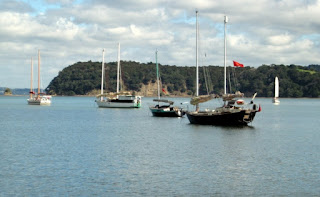

The sound of an outboard advertised Pacific Spray’s dinghy returning with the ‘shore party’: The China Moons who had flown in rather than sail the 1000+ miles from Tasmania; a new member, also from Oz, who is exploring the idea of sailing and living aboard her own junk-rigged boat; and La Chica’s owner, who had not managed to meet her launching date (when do they ever?). They all piled on board Fantail, who was beginning to get a trifle crowded. Then another boat hove into view: a fascinating lug-rigged ketch, with a pram bow. (the general consensus was probably ‘so near and yet so far’!) beautifully constructed and full of clever ideas as we found out later. This was Le Canard Bleu, whose builder is famous in NZ for building the 64ft gaff schooner, Maggie. His crew was also considered acceptable company, having sailed around the world against the wind in his Lidgard 30, which has a junk mainsail, and a jib.


As we’d run out of bubbly, the party transferred itself to Canard Bleu, and in due course everyone was drinking and talking, and the odd person was even listening, while snacks were passed round and the boat admired.

The plan for Saturday, was to head north for Bon Accord Harbour on Kawau I, about 10 miles, as the crow flies, from Mahurangi. The day dawned fair with a good sailing breeze that would have us beating in flat seas, sheltered by offshore islands. About 1030, sails started going up masts, anchors were raised, dinghies brought aboard and the yachts sailed out into the main harbour, tacking, gybing, taking photographs and admiring one another. And all secretly wondering how we were going to compare. We had to beat out between an island and the mainland and it was a wonderful sight to behold: the seven boats – as varied a selection of craft as you are ever likely to see together – sailing in line ahead and each one tacking at the same spot. It was like something out of Patrick O'Brien, but it was disappointing that there were no other boats out on the water to admire the spectacle, despite its being a fine Summer Saturday.

Footprints, 32ft overall, is designed by Gary Underwood and had just fitted a new sail; this was its first real trial; the 49ft Arcadian was relishing the conditions: she and Fantail sailed tack for tack to Bon Accord Harbour; Le Canard Bleu was crashing along in fine style, her pram bow making plenty of noise; Pacific Spray was right behind her, making good progress but really wanting a bit more wind; then came mehitabel, her flat sails belying all the latest thinking as she inexorably worked her way through the fleet, finally being the second boat to sail into anchor.

It was fascinating to watch the different boats. Footprints and Fantail each had to reef, and Tystie dropped one later in the day, but the other boats were probably in their ideal conditions; apart from Pacific Spray who sailed at her best later in the afternoon, when the breeze hardened to about F6. Fantail felt a bit smug at sailing faster than Footprints, but as the battens from her previous sail were proving too flexible, this satisfaction was undoubtedly unwarranted.

Late in the afternoon, we all brought to at the east end of Bon Accord Harbour and the cooks got to work: at 1800 we were to assemble for sundowners on the beautifully-fitted out Pacific Spray, followed by a potluck supper. Although only 38ft long, Pacific Spray is huge and there was plenty of room for the thirteen people who eventually sat down to dinner and enjoyed a thoroughly convivial evening.

Fantail’s yard was made by a friend, to a similar design as that used by Arne Kverneland. At the time he gave it to me, Paul was thinking of putting wing sails on his boat, but subsequently changed his mind and wanted to use his original spars. Very kindly, he offered to make me a replacement, tailored specifically to Fantail, a much smaller and lighter craft than La Chica. I had intended to swop them on Saturday morning, but had run out of time. On Sunday morning, it was blowing a bit briskly and forecast to stay that way. The plan was to head back to Mahurangi, but I really didn’t want to beat back against F6, so I contacted mehitabel and asked them if they would be kind enough to collect the old yard from me and take it back with them. The skipper soon paddled across, not only to take the yard, but to help me remove and replace it, a much-appreciated gesture. I undid the lashings and as I started to slide the yard forward, he commented that it looked a bit odd. I went back aft where I had a better view and to my horror could see it was seriously bent – deflected from straight by about 6 inches! I had noticed it bending the previous day, when beating on the starboard tack, and was a bit surprised, as I’d never seen it do so before, but had assumed it would have straightened itself out as we went about.

After some debate, we decided to carry on and replace it with the new one, but the bad news for Paul was also bad news for me, too, because the new yard was significantly smaller and lighter. If Fantail could bend the heavy one, then the new one was obviously not going to handle much wind at all; but at least we had a yard to sail back north with. The only consolation was that La Chica has not yet been launched so the new yard can be made while a workshop and facilities are still available. Even so, I felt less than happy when Kurt went back the banana-shaped yard.

By now there was some debate among the seven boats at anchor. The wind was increasing and the anchorage was becoming less and less comfortable. Pacific Spray said they were off to Mansion House Bay to visit said house and get better shelter and four of us decided to follow and leave the following day. Footprints had to get back to Mahurangi and Pacific Spray nobly volunteered to take back those who had to get back for a flight and work.  Le Canard Bleu was also heading back. The rest of us carried on partying and rowing round paying visits before going over to Tystie for a drinks party, followed by another BYO on Arcadian. Our host kept producing bottles of wine, people kept filling their glasses, the conversation was convivial and general and the following morning everyone commented how that they’d got back on board and said: “Surely it can't really be twenty to two?!” But it was.

It was still blowing on Monday, so we stayed put again, and although officially over, the rally continued. But although we did have a drinks party - this time on Fantail – we forewent the BYO. On Tuesday, Arcadian stayed at anchor and the rump of the rally, consisting of Tystie, mehitabel and Fantail sailed back to Mahurangi. In the lightish airs mehitabel sailed like a witch making even Tystie sit up and take notice. Once in the harbour, the three boats anchored in different places and the rally officially came to an end.