The reason that I haven't updated this blog recently, is because some time ago, I started a new one. To catch up with FanShi and me, please go to FanShi: Wandering and Wondering
Badger

In Greenland
Iron Bark

Under full sail
Fantail

At Russell Boating Club's Tall Ships Regatta
Blue Water Medal

Blue Water Medal
About Me
18 January, 2023
One or two people have commented that I haven't updated my blog recently.


07 September, 2022
Change of Pace: Change of Blog
 For some time, now, I've been considering abandoning blogging
altogether ... but I suppose that it's a case of once a writer, always a
writer and I find blogging much more satisfactory than trying to
contort my work to fit in the spaces allowed in the twenty- first
century yachting press.
For some time, now, I've been considering abandoning blogging
altogether ... but I suppose that it's a case of once a writer, always a
writer and I find blogging much more satisfactory than trying to
contort my work to fit in the spaces allowed in the twenty- first
century yachting press.
However, voyaging I am not. Moreover, this Google account is now almost full, due to the myriad photos I have posted on this blog over the past several years.
For some time, now, I've been considering abandoning blogging altogether ... but I suppose that it's a case of once a writer, always a writer and I find blogging much more satisfactory than trying to contort my work to fit in the spaces allowed in the twenty- first century yachting press.
However, voyaging I am not. Moreover, this Google account is now almost full, due to the myriad photos I have posted on this blog over the past several years.
My blogging is now heading off on two different trajectories.
One is a blog that is standing in for the cookery book I never wrote: The Voyaging Vegetarian. As a book, this has been a generally-stalled project for at least 20 years, but I actually think that a blog might be a better way of presenting it, allowing me to add recipes and ideas as I go and, with luck, respond to comments and suggestions. For years it seemed something of a hopeless task, anyway, but now that finally people are becoming aware of just how devastating our livestock farming is to the planet, it's time may have come. Anyway, for those who are interested, head over here and have a look.
The second blog is reflections on my wandering, rather than voyaging life, still afloat, of course, on FanShi. As I'm quickly running out of Gmail addresses with lots of storage left for photos, to tie the blog to, I've decided to give Word Press a try. This blog, "Fanshi - Wandering and Wondering", can be found here. Not the most original of names, I know, but I wanted the title to reflect the flavour of what I hope it to be.
I won't be adding to this blog any more, so please don't leave any comments here, but instead post them to one of the new ones.
I hope you find something to enjoy in either or both of them. And thank your for reading this blog, and for all the kind and interesting comments that have been left here over the years.
Annie
16 January, 2022
FanShi is one year old today
FanShi and I are celebrating her first birthday, in a beautifully sheltered spot in the Bay of Islands, called Hauparua Inlet. It's pretty shallow - we are in about 1.5m at LW, but has land all around it and with 80ft of chain out, I'm feeling pretty secure. I have wondered about this place in bad weather and as the met service is talking about the remnants of cylone Cody sending 6 metre swells our way, I am pleased to be sheltered here. I think the swell would have to work hard to get round all those corners!
However, as if a cyclone were not enough, we have had tsunami warnings due to the volcanic eruption in Tonga. I've not been aware of anything unusual, but my friend, Gordon, reckons something must have happened last night, because he woke up to find himself rubbing in over-friendly fashion alongside a launch. And this in barely any wind, after his anchor had held through a couple of days of gale-force gusts. You might recall me writing about the friendly little marina at Tutukaka: well that has been badly damaged with the tsunami piggy-backing on the already-exceptional swell. Several boats have been lost, but fortunately no-one seems to have been hurt. However, I fear the poor Tongans will be in a shocking state, but we don't know because all their communications seem to be down at present. These tiny island kingdoms are feeling the onslaught of climate change; how sad to have to face damage from a volcano erupting as well.
 | |
Since I last posted a blog, FanShi and I have been working on the art of Living Slowly. Although I have been sufficiently brainwashed to feel guilty if I'm not being productive, intellectually I feel that time to stand and stare is far more important than a life of busyness. Surely being happy can never be a waste of time? Anyway, I'm pleased to say that I often feel like Pooh Bear: "People say that nothing is impossible, but I do it all the time". And, as I haven't been doing very much, this blog is largely of photos, all taken in the Bay of Islands, which might help explain why I am so much enjoying life here. Unfortunately, the doing nothing also applies to photos, so there aren't as many as there should be!

This is a view from Urupukapuka taken in September. Gales were still coming through rather frequently, but the longer days persuaded me to drop the mooring now and then. The Bay is almost deserted and it stayed like this up to and including Christmas Eve. It's now very crowded, but soon people will be going back home again, and those of us based here can have it to ourselves once more.

Zebedee and Tystie seen from an anchorage at Moturua. It is a real joy having some of my junkie friends based here, too. We always enjoy meeting one another and it's great fun to have an impromptu junket. In this instance, Tystie had just sailed out and Zebedee was just about to sail in.

Finally, the saloon seat covers are made. It took me ages to find a fabric that I liked and in the end I chose something entirely impractical, which will need to be washed every couple of months. But they do look pretty and really 'lift' the saloon.

I now have plenty of time to cook, which is a real treat after all
the years spent building. Indeed, I am in danger of being obsessed, spending far too much time perusing new recipes, trying out ideas and spending time in the galley. Here is one of my frying pan pizzas. I experimented with a vegan mozzarella, which was very satisfactory. So far, it is the only decent vegan cheese that I have managed to buy. Veganism isn't a big thing yet, in New Zealand and up here in Northland, my request for a vegetarian alternative is usually met with either the offer of a cheese omelette (which, yes, doesn't contain meat, but is somewhat aggressively animal-oriented) or the suggestion that I might enjoy some fish. "But fish isn't a vegetable", I reply and am greeted with a blank stare! (I am exaggerating - but not by much!!) Either that, or the restaurant
has gone to the other extreme and offers me something gluten-free (I like gluten), made with beetroot (which I dislike), quinoa and chia seeds. There are thousands of 'naturally' vegatarain and vegan meals around - why do they have to invent something weird and - to me - unappetising? As I can't really afford to eat out, it's not a problem, but when I look at what's on the menu at most places, I wonder at how few places offer really good veg(atari)an food. So I cook for myself and really enjoy spending time over it, as well as not feeling that I'm missing out!
 | ||
I've always wanted to go up the Waikare Inlet. When I was building the boat and used to come up to visit my friend in Russell, it always attracted me because the old road that I used runs along it in places. The inlet always seems deserted; there are very few houses and whenever I saw it, it was calm and tranquil. It's reputed to be shallow and very few people i know have ever explored it, so I decided to take full advantage of my shallow draught and sail up as far as I could get.
 |
In fact there was plenty of water most of the way, but right at the head (and well off the chart) it obviously was going to dry out. I settled down quite happily onto the less than smooth bottom, riddled with mounds of Pacific oysters I was glad that I had decided on an external ballast keel! At low water, it wasn't exactly scenic and, being constrained
by the tide as to when I could leave, not really worth it. But it was an interesting experiment. The tide around BOI is only a couple of metres, and generally, I have found that there is no need to dry out. I can find plenty of depth and there always seems room for a shoal-draught, 8m boat. I think that most people never look at the tide tables to see how much above chart datum LW actually is. Thatt's great - all the more room for me!

The next day we went back down about half a mile and found a much more pleasant spot. I really like this photo. To me it could be in China - not that I've ever been there! - but the low angle has turned the hills into mountains and the lighting is evocative.
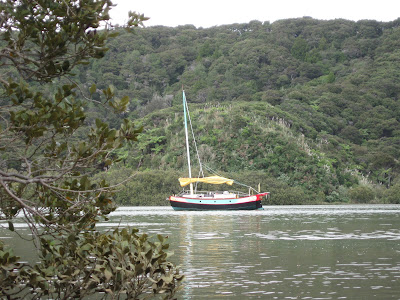
I enjoy being anchored near mangroves which I find very restful. It's interesting to watch the different birds and I love the basket sof roots and branches, exposed at low water. A black swan flew into my present anchorage yesterday and made straight for the mangroves. I wonder if there is a nest there - you don't often see a lone swan. Mangroves are important habitats for all sorts of animals.

On a fine, spring day, we sailed up and anchored in the Kent Passage. The forecast was for strong winds in a few days, but there was enough time to get a change of scenery and the Kent Passage is only about 5 miles from my mooring. (I am now renting a mooring in Matauwhi Bay. Apart from anything else, it saves wear and tear on my expensive anchor chain!)

Motoroa is a privately-owned island, which is also a wildlife sanctuary. I am not sure how this all works, because there were sheep wandering around on the beach, there are several large houses and I know for a fact that the winery there is not organic. Like the other islands in the Bay it is pest-free, which must be a bonus to the land owners, but I gather they are pretty positive about the wildlife. It must be fabulous to live on one of these islands, as the endangered birds get reintroduced.

The view from where I was anchored was
very pretty, but I regretted the decision to stay the night, because far too many
launches were coming through the passage at a rate of knots and creating a
horrible wake. It astonishes me that there is no speed limit, because you often see people on the beaches on both sides of the passage, and some of the wakes would be dangerous to children or even adults, if they were caught off their guard.

However, the wakes were far enough apart that I was able to enjoy cooking and eating a delicious warm salad, wth some of the glorious vegetables that I had bought at the Paihia Farmers' Market. Although you wouldn't believe it, when you are shopping in the supermarkets, fresh food is one of New Zealand's delights. Roadside stalls and farmers' markets are often supplied by people who really care about their produce and they are always pleased when you tell them how much you appreciate it. I recently bought a bag of 7 good-sized avocados (supposedly seconds) for $5 and a huge pile of peaches (also seconds) for $4. Food is generally expensive in New Zealand, so as well as getting much better fresh stuff, its great to be able to buy it more cheaply. While I will have to guzzle down the peaches (such a struggle!), the only thing that I can see that makes the avocados seconds, is that they are asymmetrical. I can live with that.

The next day I left early before the launches started coming though, and sailed back to Russell with a light breeze, bright sunshine and a sparkling sea. It was a perfect morning and a delightful sail: exactly the conditions I had in my mind all the time I was building this boat.

November arrived and suddenly
it was summer. I celebrated the return of the hot weather with my first
cold beer of the season, on the Russell waterfront. I have no fridge and am used to beer at bilge temperature. The nice thing about buying a beer out is that usually, they are so incredibly cold, that I find it unpleasant. However, I pour a little into my glass, which warms it so that I can drink it without fear of permanent injury,. By the time I've finished that, the rest of the beer is no longer painful to swallow. Better still, because it takes a long time to warm up, I can make the one bottle last a long time. For me a cold beer on a hot day is a real treat, the more so for being a fairly rare event. I love to have one in Russell where I can sit outside and look over the Bay or watch people as they go by.
 | |
Come December, the pohutakawas starts to bloom. I love thesse trees, with their complex shapes and the way in which they cling to cliffs and crevices, exploiting every last bit of 'land' to grow on.

it was wonderful to spend a few days in an anchorage and to watch the red glow spreading over the trees. It appears, as you might expect, to start on the north face of the tree and then slowly move along until the whole tree is a mass of flowers.

We sailed
back down Te Puna Inlet and beat up the North shore of Moturoa and then
across to Urupukapuka. The conditions were so perfect that I throughly
enoyed tacking to windward: something I generally try to avoid. I have managed to wrestle my sail into submission. FanShi still suffers a bit from lee helm and the extra parrel that I've fitted to the yard makes the last three panels of the sail difficult to raise, but the boat is now sailing well and giving me a lot of pleasure on all points of sail. However, I don't think I'll ever enjoy going out in much wind. I gave the boat plenty of sail area and we often reef in F3. Poor boat - I dislike going quickly, so she is rarely given free rein.
 |
A friend, working on Moturoa, took a photo as we sailed back, but the little blob of yellow is very hard to see! He was quite envious, poor man.

We
anchored in Paradise Bay, off Urupukapuka I. The next day I went ashore for a long walk and to see the birds. Well into the breeding season, the island was alive
with tieke/saddlebacks,, which have been re-introduced as they were wiped out by rats, stoats, possums, etc. They are the most delightful birds, gregarious and noisy, they seem to fly about in large family groups. They also seem to be good-natured birds - I've never seen them squabling - and I think the first brood of chicks must help with the second, because the young tieke were being fed by more than two birds. All those that were origially released have leg bands, and I was delighted to observe that none of the many birds I encountered had a band. They are flourishing.
There are also far more of the native birds that can elude predators than there used to be. I saw large numbes of tomitits, banded rail, tui and
piwakawaka/fantail and heard many robins. Stoats, rats, possums and even mice attack all our birds and of course cats, domestic and feral wreak carnage on birds, lizards, skinks and insects. Apparently some giant weta have also been released on Urupukapuka. These are a cricket-like insect as big as my fist and I'm not entirely sure that I really want to see one at very close quarters!

Out of the bush there are far fewer birds, but the views always make it worth walking the extra distance.

People are permitted to camp in a couple of bays on the island and there's a small cafe. Tripper boats bring people to come and tramp over it. to admire the scenery and enjoy the birds. Because of this the bush won't be allowed to cover all the island and sheep may safely graze for a few more years yet. However, in the middle of the day, if there is no wind, it can be very hot work, tramping up the hills.

It's always a bit of a relief to walk back into the bush, where there's plenty of shade to be found and, of course, the wonderful birds. I've managed to take some photos of the birds, which are nice for me to have, but my camera lens is too wide-angle for decent shots, worth posting on this blog.

I can't resist taking photos of my ittle ship at anchor, and I hope I will always feel the same lift in my spirits whenever I see her sitting there, waitng for me to row back.
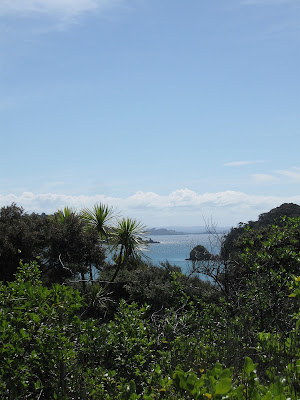
I am incredibly fortunate to be able to call this stunningly beautiful area home. I'm even more fortunate that I can live here on my own boat and be able to move around from one delightful anchorage to another. Nick Skeates told me he reckons that God created New Zealand when He decided to take up cruising. I think he might be right.

With their beautiful red flowers blooming in December, you can see why pohutakawa are regarded as Christmas trees!

And leading up to Christmas, we had day after day of this weather. No wind over F3, warm sunshine, calm sea. Absolutely my ideal sailing conditions.

And this magical, misty morning was on Christmas Day.
This life I live on my lovely boat, in this beautiful part of the world, is a precious gift. I savour every day and am very aware of my incredible good fortune. FanShi and I are very happy. We may even decide to stay here.
25 July, 2021
Windy, wintry wanderings.
Before I go any further, I must apologise for the formatting in this post. I normally compose as I go, but this time did a lot of copying and pasting having typed in advance from entries in my logbook and diary. Because of my somewhat limited computing equipment, trying to reformat it proved impossible. My apologies.
My last post was written in Whangaruru, waiting for a gale to pass. I had left Urupukakpuka Bay with a ten-day forecast for lots of SE wind, but I thought that if I didn't get away then, I'd probably pack in the whole idea and spend the entire winter in the Bay of Islands.
I had expected to be in Whangaruru for a few days, because there was no sign of a fair wind for a week, but as I was in no hurry and surrounded by glorious bush and scenery, I was quite happy to wait. Once in the harbour, I made a bit of a tactical error: the forecast SE winds turned out to be S and although not directly blowing into my anchorage, they were eddying around in enormous gusts, with a nasty chop coming around the corner at me. The previous day, a local had come by to look at FanShi and suggested that I might be more comfortable over by the moored boats. I should have taken his advice.
By afternoon, the F9 gusts had dropped, although some of them were still gale force. However, there were lulls of about half a minute between gusts, and many of them were only about F5 to 6 anyway. The wind was still S and set to stay so for a while, so I decided to shift berth. I started the outboard and let it warm up while I took in 60ft on the anchor chain and lowered the starboard bilgeboard. Then I went back and put the engine in slow ahead. It really made very little difference, even in the lulls, but I felt it might just help when I came to break out the anchor. Well either it, or a handy gust, did the job. I rattled in the rest of the anchor and moved back to the cockpit and wound up the throttle to about half way. One of FanShi's many endearing traits is that the bow takes its time to fall off. I think this is an advantage of designing for plenty of balance on the sail: the mast is further aft. Of course having a board down helps, too. There was quite enough power to be able to go across the wind while heading up a little, in case of a particularly strong gust. Once in the lee of the waves, even less power was needed to work through the moored boats. I would have liked to go into shallower water, really, but it was far too gusty for the sort of careful manoeuvring that this calls for. I put the hook down in about 12ft HW with 90ft chain. The wind continued to push us about as it eddied around hills, trees and other obstacles, but in comparison with my previous spot, the water was like a millpond. However, there was barely a signal for my phone, so it wasn't easy to get a weather forecast. Because of the truly unpleasant conditions I became obsessed with trying to get one. I suppose I was hoping for good news!

The gale force winds continued. Even though we were more sheltered, horrible squalls came punching down on us. However, apparently, there were 5+ metre swells rolling in from the east, sufficiently nasty that the land forecast was mentioning them and the consequent threat of inundation, due to the big spring tides – pity the poor folks ashore tonight. For me, the worst part of these gales is the noise. I really don't "do" loud noise in any of its manifestations. On the plus side: David’s wonderful design is as stiff as the proverbial church. We may have been swinging all over the place, but so were the other boats, due to the strong tidal stream in addition to the wind was eddying round the features ashore. However, I was weary of the whole thing and not particularly uplifted by the forecast, or the fact that even once the gale had abated, the huge swell would be there several days after the wind had dropped.
Still, we had plenty of food and grog. The anchor was holding and there was soft mud to leeward. It could have been a lot worse and I was grateful that I have decent ground tackle. However, on Tuesday night the wind either went further E and/or increased, so that both wind and waves started hooking round the headland, while the tide swirled us around. Between gusts, the boat would swing back into the stream, and then a gust would come and back she'd go. In the meantime the waves were coming from ahead, the beam or astern. It calmed down, finally: the tide lessened and the wind shifted, but I was a bit bleary-eyed when I got up! It took me a couple of hours to realise that we had dragged and to say I was shocked is something of an understatement. I have a 10kg Manson Supreme and 8mm chain. At HW we were on a scope of 8:1 and at LW of 16:1. We'd only dragged a few boat lengths, but even so … I suspect that the strong tidal stream, which appears to be almost like a whirlpool at times, has scoured the bottom of the channel. When I first crossed an ocean in Stormalong, in 1975, I remember a friend comforting me when I was upset about something: ‟Annie, with this sort of sailing the highs are a lot higher ... but the lows are a lot lower”. Steve was quite right: say what you like about living on small boats, you never forget that your are alive, even if sometimes you wonder for how much longer!

Thursday morning dawned sunny and calm and it was a beautiful day. A friend called by to see me, on the way up to Russell, and he offered to drive me down to the bottom of the harbour to look at the surf. In spite of the fact that the wind has been less than gale force for 24 hours, by now, there were breakers all the way across into Whangaruru between the headland and the island. There is another way of entering the harbour leaving the island to starboard and passing between it and some rather nasty rocks about half a mile to the W: the surf was breaking across there, too, and on a shoal out to sea. Looking at the chart later, the only shoal that it could have been has14m over it. The roadway in front of the little houses that line the beach, was covered with small rocks, shells and seaweed and the locals were all gathered about gawping. It obviously wasn't just I who thought this was somewhat exceptional weather. On odds, I thought I should take back my complaints about the unpleasant nights I was, in fact, very well protected.
I stayed put for a few days until the swell died away and the forecast became more reasonable. In the meantime, I upped anchor a couple of times, while I was waiting, to explore a couple of other bays. Calm, clear nights allowed me to watch the full moon rise, splendid in the crisp, cold air.

Finally, I had a pleasant forecast and sailed to Tutukaka. We had a really lovely sail down, although I did have to motor first thing, in order to overcome the tide.

I wanted to get there sooner rather than later, because the wind was forecast to increase significantly and of course, the days were so short, this being June.

We made it in daylight and I had time to choose my anchorage and enjoy the last of the daylight.
Tutukaka has a small marina, and I approached them to
see if they would allow me to use their facilities. I was astonished
at how welcoming they were: apparently more than happy for sailors
out at anchor to use their showers and washing machines and to be
able to dump their rubbish! Sadly, this is an unusual attitude, but I took full advantage of it, putting a load of washing through, taking
a nice, hot shower, dumping my little bit of rubbish and recycling,
and topping up the water. I also bought about 10 litres of petrol, while I could easily do so.

I was delighted to see that, when the marina was constructed, they had included the most magnificent pohutakawa tree.

Its great trunk grew out horizontally and then turned at right angles. Wonderful!
There are several restaurants around this little town – a popular place for second-home owners and day trippers – and I considered treating myself to lunch out, until I saw the prices and the token vegetarian offerings. Ah well, think of the money I saved.
With a particularly promising forecast, we left Tutukaka at about 0500. Habitually insomniac, it occurred to me, as I lay in bed, that if there was a breeze ‛outside’ I might as well get underway. Checking the ‛nowcast’ I discovered that we had a westerly breeze of about 6 knots, plenty for FanShi. There was a bright moon and a set of leading lights reassured me as I went out through the rocky entrance.

Once clear of the dangers, I could shut down the engine and we had a truly delightful sail, watching the sun slowly rise out of the sea (sadly hidden behind clouds part of the time). My original plan had been to just tuck into Whangarei Harbour at Urquhart’s Bay because the crossing of Bream Bay is always something of a challenge for a small boat: 30 miles with no chance of an anchorage. Starting as I had, from Tutukaka, it would be 47 miles to the nearest place I could get my hook down, unless I put into Whangarei. However, we brought Bream Head abeam at 0930, the forecast was for SW F3 possibly 4 and it seemed like the perfect opportunity to get across the Bay. Doing my sums and assuming 4 knots, we should comfortably be at Leigh by around 1700, with an hour in hand, before it became completely dark - and FanShi was bounding along at a good 5 knots. The boat is possibly faster and definitely more comfortable than her predecessor, and being joined by a couple of dolphins for half an hour, together with a close encounter with a Bryde's (?) whale and calf, made the sail one of pure delight. However, an anchorage is never gained until the hook hits the bottom, and so it proved this day. Rain showers along the coast had been of little concern, but as I got closer in, aiming for Cape Rodney, they made their presence felt. The wind became more gusty, generally increased and, worse, headed us. From bowling merrily along, we were struggling to lay the Cape. This is when I made a rather unpleasant discovery. A few weeks previously (in a continuing effort to eradicate the lee helm that I have, due to some flaw in the sail design), I had fitted a luff hauling parrel to the top sheeted batten and it had been working very nicely. I had also avoided going out in much wind and on the occasions that it had blown freshly, I was generally running or reaching and well reefed. This was the first time of pushing the boat to windward in F4/5. I had never thought about the fact that a sheet at one end and an LHP at the other, must put considerable compression forces on a batten. Generally, this wouldn’t be an issue, but in my case I have hinged battens, and as I hauled in the sheet, the top sheeted batten was bent excessively – as hard as the double cones would permit. The sail has camber built into it, as well as the hinged battens and it seemed to me that the camber was definitely excessive and the sail was really quite distorted, especially as the boom and lower batten had taken a kink in the opposite direction. For some reason, the leech of the sail had a terrific twist and regardless of how hard I hauled the sheet in, the top of the sail was well to leeward. The poor wee boat did her best, but the sun was getting lower and at this rate, my ETA would be about 2100. I didn't know Leigh, having only poked my nose in once, about 6 or 7 years ago, and with so much S in the wind, I would have to go right into the harbour to get shelter. I didn't fancy going on in the night, so I thought I could at least have a try at motorsailing, something of a new experience for me. If I could lay the Cape and keep up about 3.5 knots, we should just make it before it got completely dark. I had a full tank of fuel, so I started the engine, warmed it up for a couple of minutes and then put it into gear. I opened up to about half throttle and then took another reef or two in the sail, which flattened it somewhat, although the top sheeted batten was still very distorted, even after slacking the LHP, which doesn't do much with the sail well reefed. It was touch and go, but we made it and I was actually very pleased with how well the concept worked. FanShi, effectively has two transoms, with the engine attached to the inner one. The idea of this is to reduce the chances of the propeller coming out of the water in a chop and it worked perfectly. I couldn’t make out much when I entered the cove, which has cliffs and trees around it and was really quite dark, so I took the risk of picking up an empty mooring. (One of the good things about moorings in New Zealand, is that part of their resource consent is a condition that they are professionally maintained and regularly checked.) It was totally sheltered, and most of the boats around me were fishing boats my size or larger, but I was concerned about a fisher coming back and wanting the mooring. Thankfully no one did and I settled down with a large drink and jangled nerves. It had been an epic 47 miles, but we were now officially in the Hauraki Gulf.
Next morning I decided to go round to Whangateau,
about 5 miles away. It was flat calm (which had been forecast, and
was one of the reasons I had pushed on the previous day), so the
little engine earned its keep again.

I raised the sail in case a breeze filled in, and noticed that the top-sheeted batten was still very kinked.


It had in fact broken, just abaft the hinge and looked as though the point of the cone had pressed against it and stressed it too far. Fortunately, a few weeks earlier, I had bought 250mm of nylon rod to replace the hinge in the boom, which had an annoying tendency to bend the wrong way as soon as I dropped a reef. I hadn’t got round to doing this, so still had the rod. I removed the batten, cut off the ragged ends and slid the rod into the batten, securing it with screws. Of course the batten was now too short, but the very top one is shorter than all the others, so I swopped them around. Thinking about the sail, I couldn’t help feeling that the camber plus the hinges were excessive. I decided to order sufficient rod to replace them all, when I had the chance, and in the meantime consider the matter more.
Another NE gale was was forecast and at first I thought I’d sit it out in Whangateau. However, the longer term forecasts were talking of at least a week of E winds, which would build up a swell. I wasn’t entirely sure that this wouldn’t find its way in to where I was anchored, and I was certain that I didn’t fancy crossing the bar at the entrance until the swell had died down. Thus, the next day I sailed round to Kawau I, which shelters a large bay and provides a choice of anchorages, such as North Cove and Bon Accord. The sail looked a lot happier when I hoisted it and we had a pleasant sail to North Cove, where my friend, Mike, had organised a mooring for me. I stayed there for several days while the wind howled outside, but only the odd gust moved us around. It must be about the most sheltered mooring in that very sheltered harbour!

I have a friend who has recently bought a delightful boat that was originally built as a three-masted lugger. Paul has converted her to a three-masted junk and, while he completes the refit, Le Canard Bleu continues to lie alongside at Maggie’s Landing, in Sandspit, where her previous owners live. Many moons ago, Brian dug out the existing creek through the mangroves – by hand! - to make room for a boat to be kept there. Maggie herself, which he built, lived there for many years: all 70ft of her!! I was invited to go and lie astern of Le Canard Bleu, something for which FanShi is ideally suited. I decided to sail over, anchor and walk round to Brian and Andy’s place to see what was involved.
When the wind finally moderated, I sailed the few miles to Sandspit and followed the line of moored boats up the narrow channel, looking for somewhere to spend the night.


Near HW the next morning, we once again made our way along the channel, which is dredged as far as the marina. From there, I stuck closely to the moored boats and then turned between the very last two, to negotiate the creek. At the top of the tide, it was something of a guess as to where the channel would be, and I certainly didn't want to run aground, but I managed to stay afloat and tied up astern of Le Canard Bleu, with Paul and Brian standing there ready with lines and advice.
 What a wonderful
place to keep a boat!
What a wonderful
place to keep a boat!

It is completely sheltered and the only drawback is that there isn’t much sun in the winter; FanShi started to get damp after several days of steady rain and low temperatures. Part of the reason for her colour scheme is to provide passive heating in the low sun of winter, and I realised that it obviously works!
Paul had just installed a new Dickinson range, and we had
great fun setting it up and trying it out: I cooked on something
similar for several years and could help Paul adjust its settings.
He and I hadn’t
seen much of each other over the previous few years, and it was good to catch up again.

Mutual friends visited while I was there, Brian and Andy took me to Warkworth and he waited patiently while I filled up numerous bags at Bin Inn, with beans, polenta, spices, etc, and a friend and I attended Matakana Market. I managed to get a few little jobs done, including getting more of the nylon rod, which I put in the boom and the top-sheeted batten, and generally had a wonderful time. It was hard to tear myself away!

I was treated like royalty, with Brian and Andy as
kind as you could conceive. From doing my laundry, to feeding me,
and cutting up firewood for my little stove, they couldn't have been kinder.

However, it was time to move on and I left one afternoon and sailed across to Algies Bay.

Dawn broke calm and clear and it was wonderful to be able to watch the sun rise next morning. I always try to watch both sunrise and sunset and miss it when they are hidden by high land nearby.
I had arranged to rendezvous with another boat-building friend, who had recently completed a small catamaran. We shared G&Ts and lunch aboard his gorgeous wee ship, which I could easily imagine spending a whole summer on: she is a poem of simplicity and function, with all that you really need on board. She is also extremely cute, which David did not regard as an appropriate compliment! Sadly, he had to get back to his mooring and motored off in the light wind. I followed to find an anchorage in Te Kapa River, where I could watch the moonrise

We were anchored in Mahurangi Harbour, and I had every intention of setting off up river to the town the next day, to check out the op shops (thrift stores) and buy a few more bits and pieces. A floating pontoon is provided for visiting yachts, and the idea of a night or two alongside in the attractive little town, was appealing.
The next morning, I started heading up river, but suddenly I didn’t feel happy about it. The weather forecasts continued to be very unsettled and as ever, I was juggling tides, forecasts and the length of the day. I realised that I’d had enough of this winter cruise: there was more of endurance than enjoyment. It was time to head back to the Bay of Islands and snug myself down there until spring.

Accordingly, I turned the boat round, let the sail out and headed for North Cove once more. I was pleased that I'd done so, when the forecast S gale proved to be very uncomfortable, even in my sheltered spot.

I took advantage of my wait for weather to start making new, loose seat covers for the saloon. On a small boat, the chances of getting either rain- or sea-water on the cushions is quite high, so they are covered with plastic coated fabric to keep the foam dry should this happen. However, this in't pleasant to sit onand I presently have woollen rugs over them.

The plastic is dark green and the rugs dark blue, so it makes the cabin rather gloomy. The fresh, printed fabric that I finally chose will look much brighter. Unfortunately, I ran out of thread before I'd finished sewing the first cover!

It was cold enough that the fire was very welcome almost every morning and evening. Mike kindly sawed up firewood for me, that Lin and David were to be rid of. It's fun to cook on the little stove!

Or just to sit in front of it and watch the flames.

It was time to 'bottle' some more of my home-made wine (I use wine kits). This goes into 4 litre containers, rather than posh wine bottles!
They make a lot of sense on a boat, if you rarely go alongside. Carrying bottles – or even boxes – of wine gets to be too much of a good thing, and then you have to dispose of them, too.

I stayed in North Cove for 10 days, having a grand social time there, while I waited for the wind to change, so that I could head north.
On 5th July, I left North Cove debating the virtues of Leigh and Whangateau. If I went to Leigh, it would mean 3 miles less to go on the next passage.

However as I was approaching, it became apparent that the wind was much more S than forecast and blowing straight in. I altered course for Whangateau.
 Just for a change, the forecast was for fresh to
strong NE, so I stayed a day or two and visited a friend who runs a
boatyard there.
Just for a change, the forecast was for fresh to
strong NE, so I stayed a day or two and visited a friend who runs a
boatyard there.

I looked at various forecasts before leaving: one was a bit dubious – gusting 30 knots – but the others looked more moderate. We had a lovely start and were doing well and having a great time until about Bream Tail.
Here the wind started to pick up due to the large number of rain
squalls about. I was putting reefs in and taking them out
constantly, and even with junk rig, it started to get very tiring. Unfortunately there was just too much wind in the gusts to leave the sail up and just too little in the lulls to make progress, close hauled as we were. By the time we got to Urquhart's Bay, the wind
was dead on the nose andI resorted to motor sailing. It had really been a very unpleasant sail, but we had made good time.

We anchored just off the entrance to
Marsden Cove marina and the wind completely died away. I was
there to visit friends (otherwise I would have stayed in Urquhart’s),
and once I was settled, Rob came and picked me up. I was
showered, wined and dined, andwould have really liked to stay longer with these good friends, whom I hadn't seen for too long.
However, with E gales forecast for Sunday, my choices seemed to be to sail up to anchor off Norsand, carry on to Whangaruru, or go into the marina. As tired as I was, the latter didn't lack appeal! In the other hand, we could stop in Tutukaka overnight and get to Whangaruru before the next gale came, which would be that much closer to the Bay. By now I just wanted to get ‛home’. 9th July came in with a forecast of W 20 knots – rather more than I’d have chosen – but I left anyway, just before sunrise and we had a lovely sail down the harbour, and along to Bream Head. From past experience, I put in two reefs when we got there, and then we set off towards Tutukaka.
Again it was much more blustery than I’d
have chosen and I certainly couldn’t relax, but the two reefs were
sufficient for the lulls and not too much for the squalls, so it was
much better than the previous day. However, the third reef
went in about 4 miles from our destination. I put the motor on
outside the harbour, dropped the sail and motored in.

The wind was dead on the nose and a squall blew for a while at about F5, but the motor managed without struggling, even if we were making only 2 – 3 knots. I went straight to the W end of the harbour this time and anchored in fairly shallow water among the moorings. I think the wind did genuinely die out a bit later. Anyway, I had a lovely, relaxing afternoon.
Although it's supposed to be safe, I couldn't contemplate spending an E gale there, so I plugged on again the next day. I got up before sunrise, gave myself time for breakfast and got underway about 0900, after giving the breeze time to fill in.

The forecast was for the wind to moderate and I looked forward to sailing close hauled, into the forecast F3 and making my way up Whangaruru harbour in flat water, giving me a chance to see how my various modifications to the sail worked. However, the wind died right away at around 1100, when I was expecting it still to be increasing. I could amble along all day and arrive in the dark, and probably fairly late – or I could motor. Several hours later and almost deaf, I anchored off the wharf. It was cold and overcast. I lit the fire and made mulled wine while I tidied ship and had a very pleasant evening, cooking a good meal, snug and secure. After a comfortable night, I looked at the forecasts and braced myself for another couple of uncomfortable and worrying days.
It started blowing about midday and was soon quite gusty and unpleasant. I was anchored in about 9 ft, HW, with all my the chain out. The wind picked up over the afternoon and I put out a second anchor, which made me feel a lot better. I should have thought about it sooner, but it still did some work. By morning, I am sure some of the gusts were approaching 50 knots, but thankfully the underlying wind probably was less. However, I went out on deck for some wood and didn't dare stand up, so it was probably blowing the best part of a gale between gusts. A nearby house had a bright light on the gable end: normally I would curse such light pollution, but that night, I blessed it as a reassurance that I wasn’t dragging.

After the best part of two days and a night, I woke up to a much more pleasant morning. According to the ‛nowcast’, the wind was still blowing, but it had turned SE so we were much better sheltered. It was hard to get any phone reception, but I could get a signal often enough to monitor what was happening.

The forecast made it quite clear that if I didn't leave on Wednesday, 14th July I'd be in Whangaruru for the foreseeable future. So I left. It was forecasting F3, but in fact most of the time there was less, so we did a lot of motoring and a bit of sailing. It’s not really how I’d choose to make progress, but at least the outboard seems to run well and doesn’t use that much petrol. The swell wasn't as bad as I'd expected, which made me take the short cut between Cape Brett and Piercy Rock/Motukokako. This was a mistake. We'd been sailing very nicely for a few hours, up to then, with the wind more S than SW so I thought it would follow us through. How can anyone be so stupidly optimistic? Anyway, I had to start the engine and run it for quite a while until we got out into some wind again.

I intended to beat to Te Puna: we'd made good progress and had plenty of time and FanShi was sailing quite nicely However, the wind was very puffy and unsettled. We motorsailed for a while and then I tacked and we sailed back to go through the Albert Channel. The wind died away, a sloppy sea remained, so I motorsailed the rest of the way and then dropped the sail and motored the last mile or so, anchoring once more in Urupukapuka Bay. It was good to be back in the Bay!
Another reason I had been pressing on was that I had an appointment on 15th July to get my first vaccination against Covid. In the morning, I got underway heading for Russell. There was a very light breeze but the sailing was so pleasant, drifting along, yet making genuine progress to windward. Best of all was the lovely flat sea! I could finally get some idea of whether or not the modifications I have made to the sail were working. (Yes. But I think I'll take out the rest of the hinges. There seems to be ample camber in the sail.)
Finally,
wanting to get my jab, I resorted to engine, but once round
Tapeka Point we could lay the course and we had a beautiful reach down
towards Matauwhi Bay. Off the moorings, I rounded up, started
the motor and chugged in. I picked up a mooring I am borrowing, secured it, had a quick tidy of ship and self and rowed ashore. Just over an hour later, I was back on board, jabbed and catching up
with my friend Gordon, who greeted me with a bottle of bubbly! It had been an eventful two months away.
And here we shall stay until the gales have blown themselves out.
And here, at least for the moment, I shall leave this blog. Even if I wanted to sail offshore, Covid makes this difficult. Moreover, at the moment, many countries in the Pacific are insisting that while a boat is on passaged, there is an AIS transmitter turned on the whole time. This is not my idea of voyaging.
Regardless, FanShi and I will be pootling around Northland and Auckland for the foreseeable future, spending most of our time at rest at anchor or on a mooring. This does not make for riveting 'copy', either to write or to read. So for the moment, thank you to all the people who have been following me over the past couple of decades. It has been wonderful to recieve comments and feedback and a privilege to know that people have enjoyed what I have written.

Annie
PS Journalist, Matt Vance, has written a very nice article for about FanShi. Apart from mistakenly referring to David Tyler as a Canadian, it's pretty accurate. It is a nice account of both me and the boat.
https://boatingnz.co.nz/the-beauty-of-junk/
Subscribe to:
Posts (Atom)