Search This Blog

Badger

Badger
In Greenland

Iron Bark

Iron Bark
Under full sail

Fantail

Fantail
At Russell Boating Club's Tall Ships Regatta

Blue Water Medal

Blue Water Medal
Blue Water Medal

Books By Annie Hill

  • Brazil and Beyond
  • Voyaging on a Small Income
Showing posts with label RCC. Show all posts

15 July, 2013

It was the end of January before I'd finished my refit, and I was spurred on to leave by the thought of going to the Mahurangi Traditional Boat Regatta.  Now a Raven 26, even one that's over 25 years old (and therefore, so I'm told, a 'Classic' Boat) could not by the wildest stretch of the imagination be described as a traditional boat, which meant that we couldn't enter.  However, as I am not keen on racing at the best of times and would hate to race my own boat, this was far from being a drawback.  So I decided to go as a spectator.

We had a fine sail down past Kawau Island and into Mahurangi Harbour, where we anchored amidst the fleet, not far away from Gary and Beryl Underwood's recently restored Mason Bay.  I ended up joining in the racing and with junk rig - when David Thatcher kindly invited me to sail on Footprints.  We seemed to have far less drama in the gusty conditions, than those on the gaff and bermudian-rigged boats.  Gaff rig is undoubtedly beautiful, but I will stick with junks, thank you very much.

We had a wild sail back to Whangarei, with a very fresh easterly that had us averaging well over 6 knots: including three hours of tacking, we sailed the 57 miles in 11 hours.  Fantail can pick up her heels when she wants to.  I drove the boat quite hard - normally I'd have put more reefs in - to give the rig a proper trial.  I have made a new yard, this time out of Douglas Fir, and was pleased to see that it gave no problems.

This was the last time that I had to sail in more wind than I'd ideally choose, all summer, because from then on we had the most glorious weather and predominantly easterly winds.  I spent quite a bit of time ambling around and exploring the Hauraki Gulf.  I attended a wonderful RCC Meet in Waiheke, where we pottered around to various anchorages and had some interesting visits ashore.  Fortunately, the distances were short, because we had very little wind.  Mike Robinson took some lovely photographs of Fantail.


From Waiheke I went junk hunting, meeting up with friends in Tamaki and Herald Island, who were busy getting their boats ready for launching.  Shoestring had been well and truly neaped many moons ago and it was looking unlikely that she would get off the mud in order to meet up with some other junkies in a few weeks time.  Fortunately, with a lot of effort, and a little luck, Roger got her back afloat and we met again off Waiheke, to have a little junket.  Arcadian also joined us, as did Pugwash - all 7ft 8ins of her.

 
 We didn't get much sailing done - again, there was hardly any wind, but had a fine social time of it.  It was fun to see such unusual boats together:


Shoestring sailed back to Herald Island and Pugwash went off on her car back north.  Arcadian and Fantail had to dodge a nasty blow for a day or so, but we had a splendid sail back to Whangarei, with Fantail giving the much larger Arcadian a good run for her money for a while.


Sadly, for David and Rosemary, this would be their last good sail: David has a heart problem and long-distance sailing is no longer feasible.  Arcadian is now on the market and looking for a good home.

Another boat that we missed at this year's junket, was Pacific Spray:


her owners were in Germany.  Pacific Spray is also for sale, (http://www.apolloduck.com/feature.phtml?id=304587), but for happier reasons: Rob and Maren are planning to downsize and build one of Gary Underwood's Shoehorn designs: a 26 ft version of Shoestring.  This is a boat that I find very attractive, and I'm very much looking forward to seeing her under construction.  She will, of course, have a junk rig. (http://gary-underwood-designz.co.nz).

The final highlight of this wonderful summer, was seeing the re-launch of Paul Thompson's La Chica.


Paul has spent over 7 years completely rebuilding the 32ft Tahitiana and plans a non-stop circumnavigation, to start in 2014.  He is completely deaf and is hoping to raise awareness about cochlear implants (www.sailingwithoutasound.com).  The boat is now sailing - I went along for the maiden voyage - and her teal-coloured junk rig looks quite magnificent.   


(Sorry about the small size of the photo - I filched it from the Junk Rig Associations Photogallery (http://www.junkrigassociation.org/photo_gallery).


23 May, 2012

In North Island


I felt very pleased to have made it into Whangaroa when I did.  Even in the sheltered spot we were in, we experienced  the odd strong squall, but Fantail is a delight at anchor.  I don't think she has yet snatched at her chain, even during that gale we had at Adele, and she never heels to the gusts.  I kept wondering should I let out more chain, but the holding seemed good and we hadn't moved,  I was on at least 5:1 scope.  Fantail has 25m of 8mm chain and I tend to let it all out regardless of depth, unless I’m in a crowded anchorage and might swing into somebody else.

I stayed in Whangaroa for the rest of the day, letting the blow come through.  Some of the gusts were quite ferocious, but we never moved and barely heeled.  I turned in early and slept like a log until about 0800.  I decided to head on down to the Bay of Islands, to catch up with a friend who has a house there. 


It was flat calm in the anchorage, so we left under power, but after a couple of minutes we found a breeze and could turn the engine off.  It was a lovely, sunny morning, and I enjoyed the interesting scenery along the shores. Then we lost the breeze, so it went back on to take me out of the entrance and on for another half mile.  The rest of the day was on again off again as the wind came and went.  We ended up with a fine breeze, but it was too late to get to my friend's.  I should have left a lot sooner – it was further than I realised, having allowed myself to be misled by the small scale of the North Island chart.  My own fault, so I anchored in Twin Lagoon Bay on Roberton I, for the night

I was feeling tired, but forced myself to make ratatouille and pasta for tea and as I polished it off without difficulty, was glad I had done so.  As I sipped on a glass of wine, I felt it had been another great day and that I’d made the right decision to come north.

I spent the next two or three weeks cruising around the Bay of Islands, which is a wonderful, miniature cruising ground, with many bays and islands to provide a variety of anchorages.  However, we seemed to be having a particularly windy spell of weather and I got tired of dodging gales and listening to F10 winds howl overhead.


In between blows, I managed to visit several anchorages and enjoy a Royal Cruising Club meet, which gave me the opportunity to catch up with people I haven’t seen for ages.  We sailed to several different anchorages and had parties on each others’ boats.  Although the Club is based in the UK, the Membership roams far and wide and at any one time there might be several RCC boats in New Zealand.  As several Members also live here, a total of about 20 people turned up for the BBQ party ashore at a Members’ house.  Fantail showed off her paces and as everyone made nice noises about her, we felt pretty pleased with ourselves.


 A couple of weeks later, the Junk Rig Association planned a rally in Mahurangi Harbour, about 100 miles south of the Bay of Islands.  It fitted in nicely and I had plenty of time to get there.  I was in contact with other members in Whangarei, about half way between the two in the hope of catching up with them so that we could all arrive together.  The forecasts were far from reliable, changing from day to day and when I was ready to leave, it changed again with another gale on the way. Further south, in Whangarei, mehitabel and Pacific Spray made the same decision. Arcadian, also in Whangarei, had a new rig that had only been tried out twice. They too lurked, waiting on the forecast. A few days later I was sitting in a bay with Fantail getting hammered by gusts that must have been F10 at times. This storm was followed by several days of F6+, which I didn't fancy at all. Nor it seemed did anyone else: text messages and emails were flying and we even wondered about changing the venue.Two days before the rally was due to start, everyone was still cowering in harbour.

On the morning of 22 March, the weather finally gave us a break. Pacific Spray, Arcadian and mehitabel sailed out of Whangarei and Fantail, 50 miles further to the north, got underway at 0600, took the fair wind and ran with it. By tea time we were off Whangarei, with the others already in the Hauraki Gulf, and common sense suggested that I put in to anchor. But Fantail was going like a train and I decided to carry on, under reduced canvas so that I could find anchorage in daylight. However, this plan was thwarted by the wee ship who wanted to get there, and in spite of only having the top three panels of her sail, carried on at over 4 knots. At this speed I could risk catnapping (something I had never done successfully before) and we continued sailing, eventually bringing to in Christian Cove, a few miles into the Hauraki Gulf. It was Friday and we still had 12 hours before the rally was due to start. I felt quite pleased with myself and turned in for a few hours.

After a quick breakfast, I set off towards Mahurangi and had hardly got underway when I saw the unmistakeable shape of mehitabel come out from behind a headland. Of course now it was almost calm and our progress was far from fast, but light winds had been forecast and were one of the reasons I carried on overnight. mehitabel and Fantail arrived within a few minutes of each other and we brought to near Pacific Spray. Footprints could be seen across the bay, the sail going up and down as her owner tried to sort out his brand-new sail. Not long after I anchored, Tystie dropped her hook, followed soon after by Arcadian. I popped a bottle of bubbly and called them over to come and share it. The rally had begun.
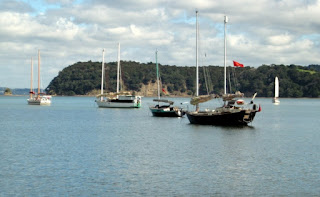

The sound of an outboard advertised Pacific Spray’s dinghy returning with the ‘shore party’: The China Moons who had flown in rather than sail the 1000+ miles from Tasmania; a new member, also from Oz, who is exploring the idea of sailing and living aboard her own junk-rigged boat; and La Chica’s owner, who had not managed to meet her launching date (when do they ever?). They all piled on board Fantail, who was beginning to get a trifle crowded. Then another boat hove into view: a fascinating lug-rigged ketch, with a pram bow. (the general consensus was probably ‘so near and yet so far’!) beautifully constructed and full of clever ideas as we found out later. This was Le Canard Bleu, whose builder is famous in NZ for building the 64ft gaff schooner, Maggie. His crew was also considered acceptable company, having sailed around the world against the wind in his Lidgard 30, which has a junk mainsail, and a jib.


As we’d run out of bubbly, the party transferred itself to Canard Bleu, and in due course everyone was drinking and talking, and the odd person was even listening, while snacks were passed round and the boat admired.

The plan for Saturday, was to head north for Bon Accord Harbour on Kawau I, about 10 miles, as the crow flies, from Mahurangi. The day dawned fair with a good sailing breeze that would have us beating in flat seas, sheltered by offshore islands. About 1030, sails started going up masts, anchors were raised, dinghies brought aboard and the yachts sailed out into the main harbour, tacking, gybing, taking photographs and admiring one another. And all secretly wondering how we were going to compare. We had to beat out between an island and the mainland and it was a wonderful sight to behold: the seven boats – as varied a selection of craft as you are ever likely to see together – sailing in line ahead and each one tacking at the same spot. It was like something out of Patrick O'Brien, but it was disappointing that there were no other boats out on the water to admire the spectacle, despite its being a fine Summer Saturday.

Footprints, 32ft overall, is designed by Gary Underwood and had just fitted a new sail; this was its first real trial; the 49ft Arcadian was relishing the conditions: she and Fantail sailed tack for tack to Bon Accord Harbour; Le Canard Bleu was crashing along in fine style, her pram bow making plenty of noise; Pacific Spray was right behind her, making good progress but really wanting a bit more wind; then came mehitabel, her flat sails belying all the latest thinking as she inexorably worked her way through the fleet, finally being the second boat to sail into anchor.

It was fascinating to watch the different boats. Footprints and Fantail each had to reef, and Tystie dropped one later in the day, but the other boats were probably in their ideal conditions; apart from Pacific Spray who sailed at her best later in the afternoon, when the breeze hardened to about F6. Fantail felt a bit smug at sailing faster than Footprints, but as the battens from her previous sail were proving too flexible, this satisfaction was undoubtedly unwarranted.

Late in the afternoon, we all brought to at the east end of Bon Accord Harbour and the cooks got to work: at 1800 we were to assemble for sundowners on the beautifully-fitted out Pacific Spray, followed by a potluck supper. Although only 38ft long, Pacific Spray is huge and there was plenty of room for the thirteen people who eventually sat down to dinner and enjoyed a thoroughly convivial evening.

Fantail’s yard was made by a friend, to a similar design as that used by Arne Kverneland. At the time he gave it to me, Paul was thinking of putting wing sails on his boat, but subsequently changed his mind and wanted to use his original spars. Very kindly, he offered to make me a replacement, tailored specifically to Fantail, a much smaller and lighter craft than La Chica. I had intended to swop them on Saturday morning, but had run out of time. On Sunday morning, it was blowing a bit briskly and forecast to stay that way. The plan was to head back to Mahurangi, but I really didn’t want to beat back against F6, so I contacted mehitabel and asked them if they would be kind enough to collect the old yard from me and take it back with them. The skipper soon paddled across, not only to take the yard, but to help me remove and replace it, a much-appreciated gesture. I undid the lashings and as I started to slide the yard forward, he commented that it looked a bit odd. I went back aft where I had a better view and to my horror could see it was seriously bent – deflected from straight by about 6 inches! I had noticed it bending the previous day, when beating on the starboard tack, and was a bit surprised, as I’d never seen it do so before, but had assumed it would have straightened itself out as we went about.

After some debate, we decided to carry on and replace it with the new one, but the bad news for Paul was also bad news for me, too, because the new yard was significantly smaller and lighter. If Fantail could bend the heavy one, then the new one was obviously not going to handle much wind at all; but at least we had a yard to sail back north with. The only consolation was that La Chica has not yet been launched so the new yard can be made while a workshop and facilities are still available. Even so, I felt less than happy when Kurt went back the banana-shaped yard.

By now there was some debate among the seven boats at anchor. The wind was increasing and the anchorage was becoming less and less comfortable. Pacific Spray said they were off to Mansion House Bay to visit said house and get better shelter and four of us decided to follow and leave the following day. Footprints had to get back to Mahurangi and Pacific Spray nobly volunteered to take back those who had to get back for a flight and work.  Le Canard Bleu was also heading back. The rest of us carried on partying and rowing round paying visits before going over to Tystie for a drinks party, followed by another BYO on Arcadian. Our host kept producing bottles of wine, people kept filling their glasses, the conversation was convivial and general and the following morning everyone commented how that they’d got back on board and said: “Surely it can't really be twenty to two?!” But it was.

It was still blowing on Monday, so we stayed put again, and although officially over, the rally continued. But although we did have a drinks party - this time on Fantail – we forewent the BYO. On Tuesday, Arcadian stayed at anchor and the rump of the rally, consisting of Tystie, mehitabel and Fantail sailed back to Mahurangi. In the lightish airs mehitabel sailed like a witch making even Tystie sit up and take notice. Once in the harbour, the three boats anchored in different places and the rally officially came to an end.


18 April, 2012

A Passage North


Fantail sails towards Adele I
For some time, I have been planning to take Fantail up to North Island, where there is an abundance of interesting cruising. Left to my own devices, I would probably have put if off until 2013, but there were two good reasons to go now: once was a planned Royal Cruising Club Meet in the Bay of Islands, the second was a forthcoming Junk Rig Association rally. My friend David, had done a huge amount to help me get Fantail fit to go to sea, and as he was most certainly going to attend the JRA rally, I felt that the very least I could do in return for his help was to show him it hadn’t been in vain, So accordingly, in the middle of February, I left my home base at Motueka and set off north.


I had been working so long and so hard on the boat, that I felt I needed a couple of nights’ rest before heading off. I find that it’s sometimes hard to change my mindset from working through the jobs list to concentrating on things like pilotage. I’d made a couple of silly mistakes when I went away over Christmas and didn’t want to do the same again, so I sailed a little way up Tasman Bay to anchor off the Abel Tasman National Park and start thinking about the passage. I hadn’t even had a proper chance to look at charts up until then.

On the morning of 16th February, I got my anchor and sailed out. I felt a bit sorry to be leaving, because I had grown really to enjoy Motueka; I wondered how I’d manage several days of single-handing and a little frightened in case I couldn’t cope. Several friends had suggested I take someone else, but Fantail is not a large boat and with someone else on board, I should have had to consider their wishes and, possibly, even try to fit in with their schedule. Going on my own seemed by far the better option.

We started slowly, but soon got a fair wind. Early on a made a silly mistake and bore away when I should have hardened in, but an hour with the motor sorted that and topped up the battery, too. I think I was still a bit tired. I fretted about keeping well away from Farewell Spit and did such a good job of it that I never even saw the lighthouse! I tried every method I could think of to decide that we had truly passed it before I dared alter course, because although I have a hand-held GPS, I still don’t entirely trust it. The wind was about F4 and we were making good progress and once into the Cook Strait, it picked up to where I was thinking of reefing - we were doing 6.7 knots at times. However, although I felt pretty anxious (at the best of times I don’t really like going fast), Fantail seemed very happy, the self-steering was coping with only one link of weather helm on it and although the motion was pretty wild at first (possibly we had wind against tide) she was coping fine.

6.5 knots the first evening
 
As ever when one decides it’s finally time to leave, there were still jobs undone. I wired in a socket so that I could plug in the GPS and replaced the fiddle for one of the bookshelves, having cut the original too short; I thought about the bolt that I still hadn’t fitted to the lower washboard, but it was really too rough to start playing around with my drill and I was worried I'd get seasick. I took a Stugeron pill, just in case. The forecast was for the wind to ease later in the day but for gales by Sunday, so I pressed on to be well away from sea area Stephens. Later on I caught a new forecast, this one from a different repeater. Irritatingly, it gave forecasts for the whole of S Island, but nothing for Raglan – the next sea area north and I was to get no further forecast for several days.

I’d had a small glass of wine to celebrate rounding Farewell Spit and an hour or so later I decided that the mast might well survive the night, the sail wasn’t tearing itself apart and nothing had come adrift inside or out. Maybe Fantail could cope with F5. On this happy note, I decided to have another glass and I suddenly realised that far from being tense and unhappy, I was feeling hugely relaxed and contented. I felt so at home and we were making splendid progress in the right direction. I didn’t feel at all concerned about keeping watch. I had seen nothing since I left Tasman Bay, apart from the lights of a rig, or a large fishing vessel in the distance and couldn’t find it in myself to worry about being run down.

I cooked a lovely meal of garlic, onions and red peppers mixed in with fresh broad beans and pasta and ate it with appetite and another glass of wine. And felt quite happy about that other glass, too!


Cooking my first meal on passage
I washed up and put everything away and when it was dark, got undressed and climbed into my bunk up forward. It was still rough, but I was surprisingly comfortable and it felt so good to be in my real bed instead of camping out down a quarter berth. I looked out whenever the urge took me, but did not bother to be religious about it.  (In fact I saw no vessel at all until I was up near Cape Reinga.)  With the bottom washboard in, I can easily get my head out to look all round the horizon, but I fitted the second because it was a bit splashy at times, and wriggling round that is slightly more difficult.  The wind took off about 0400 and I got some good sleep. 

At 0845, 24 hours out, I put a fix on the chart and saw that we'd made 113 miles.  At this rate … My ‘chart table’ consists of a piece of half-inch plywood, cut to the size of a chart folded in two. It fits at the head of the starboard quarter berth and because it extends slightly into the berth itself, never slides off. Sitting on the companionway step I can work at it very easily. It’s a great success.

The 'chart table'
  We had lost the wind  and were ambling along, more or less on course, at about 2 knots.  I still had this uncanny feeling of calm and contentment.  There I was, barely out of the Southern Ocean, unable to pick up a forecast of any description and feeling wonderful.  For some made reason, my course took me 60 miles west of Cape Egmont: I hadn’t intended to. It must have been a Freudian slip because I had thought of going more like 20 miles offshore, so I could pick up a forecast, but now I had no chance of doing so. I just hoped the 7-day rain forecasts that I’d looked at before I left, were correct.  These seem the most accurate of all, and the little charts show predicted wind speed and direction, so are ideal for the sailor.  As it turned our, they proved reliable.

So gentle the motion, it was easy to make breakfast.  The cloudscape was very familiar - a very offshore, neo-Trade Wind collection of small cumulus, all lined up in rows; the odd early-morning rain shower slowly dying away around us as the air warmed.  

The cloudscape was very familiar
There was only a very small swell running - good news for me with still over 200 miles before I could turn east.  I continued to be astonished by this, waiting for the apprehension and worry to descend like a cloud again; wondering that I could feel so un-alone.  I was so enjoying my independence; and the only cloud on the horizon was the thought of bad weather.  I am absurdly scared of this - probably because Fantail and I haven’t been through any yet.  Of course, the obvious thing would be to go out and find some, but I’m too chicken for that!

The day’s wind varied from light to calm and I motored for a while.  Only 3.6 knots - a bit of a surprise that it must be the swell, slight though it was.  I decided it wasn’t worth using the motor unless the speed dropped below 2 knots.  We sailed into a light W, which in due course became S and stayed with us all night.  Miles and miles offshore so the only radio reception was on AM. I was still really enjoying myself.

I drank my usual ration of wine.  I cooked one of my favourite meals: a salad made with slightly cooked courgette, mushrooms, green pepper, tiny plum tomatoes and runner beans and thoroughly cooked potatoes.  Dressed with olive oil and lemon, and with some walnuts and a couple of handsful of leaves it was yummy, but far too much.  it made a lovely lunch the following day!

I washed up and turned in at 2100.  Again I got up whenever I woke up, to look around.  The wind picked up a little and I altered course a couple of times.  The self-steering that my friend, David, and I made, works wonderfully well.  It steers perfectly in the lightest of winds.  In the dark of the night, we had to gybe.  Oh, it was so painless!  It took me about 5 seconds.  How I love this rig!

By 0845 on the morning of the 18th, we had made 190 miles.  Considering how light the winds had been, I was pretty pleased.  We had motored about 6 hours in total, by then.  The breeze was still only around F2, but we pottered along at between 2 and 3.5 knots, enjoying the benign weather, with a steady glass and no immediate worries.  It was so good to feel relaxed and with nothing that had to be done, after all the work of the past few weeks and months.  Motoring seemed pointless as long as we were making over 2 knots, but we were obviously not going to have a fast passage.  I just hoped no-one would worry, after all the fuss I’d made about it. 

I tuned into Radio New Zealand on AM and got the long-range land forecast.  Northerlies filling in on Tuesday and I didn’t think I had much chance of getting to North Cape by then.  However, no-one was predicting gales, so that was a relief. 

In the afternoon, I sat down with a book and read in the hot sun, but the wind got lighter and lighter and I resorted to the motor. I didn't want to push my luck by staying out any longer than I need to - not on my first offshore passage.  It was a shame to spoil the peace, but on the other hand, better to have too little wind than too much.

The wind fell away completely
 
I turned the engine off about 2100 and turned in.  I couldn’t bring myself to leave the engine on when I was asleep, because I didn’t think a strange smell or sound would wake me up quickly enough.  We didn’t make much progress, but on the other hand, a girl needs to sleep.

In the morning, I motored again.  I shut down the engine for a while and turned on the radio to see if I could get the long-range land forecast on National Radio.  I did: they were forecasting more N winds so I decided to carry on motoring. 

By 1400, the wind had picked up a bit, so I shut down the engine. I looked out about 1700 and the clouds over the land had lifted: suddenly I could see hills! It was quite a shock and a part of me was a bit disappointed.  It had been marvellous being at sea and out of sight of land.  The wind was now a dead noser, but we were sailing well, and as there was no bad weather forecast, I felt I could lose a bit of my offing.  So we carried on sailing towards the land until midnight, when I tacked offshore.

Suddenly I could see hills!
I put a fix on the chart about 0300 on Tuesday, which told me that we were heading much further W than I wanted.  While I was up, I looked at my phone to see if it had a signal.  It did, so I sent a txt to a friend to say how we were going, and to my surprise got one back - he was enjoying a night sail. So knowing that he had a smart phone, I asked if he could see what the weather forecast for Kaipara was: N breezes continuing, but not strong. However, he said the 7-day rain forecast was looking pretty nasty for Thursday.  We were still 50 miles from Cape Reinga and I decided that come daylight, we would have to try and get north as fast as we could: I didn't want to get caught out in nasty weather around the top of N Island.

At first light I could see that Fantail was really doing quite nicely, close-hauled, in F2-3. making about 3.4 knots, which I thought very satisfactory.  On the other hand, we weren’t laying the course and I’d put all that diesel on board for just this eventuality.  I didn’t want to find myself beating round Cape Reinga in a capful of wind.  The barometer was still steady, there was no swell, but ...   So I apologised to the wee ship and wound up the engine.  With the sail sheeted hard in and the revs cranked up a bit, we were soon making about 4 knots in the right direction.  As it turned out, this was a lucky decision.  By Thursday it was blowing very freshly and the barometer had hardly moved. 

We plugged on all day and I put in another 5l of diesel at noon.  I should have topped up again, but it was a bit rough and I didn’t want to spill any.  Again, it had been a good decision to keep the tank pretty full for just such a situation.  Then I read, as that was about all I could do, heeling as we were and bouncing about a bit, too.  But by no means uncomfortable.

The land inshore of 90-mile beach is quite weird, with huge sand dunes running into what appear to be low mountains.  it looks a bit like golden glaciers in the distance.  And in the distance is where it stayed as I didn't

... huge sand dunes
  want to be anywhere near that beach.  At its NW end is Pandora Bank which looks as though it could be a distinctly nasty place to be in any sort of wind or swell.  We still had little of either, but I wasn't going to take any chances. On the other hand ... I moved my waypoint much closer to Cape Reinga, taking care to avoid the overfalls shown on the chart.  Even so, there were several miles of quite unpleasant jobble, 10 miles out.  I would give it a very wide berth in bad weather.  God forbid I should ever have to.  By 1500, it looked as though we might have some tide with us, as we were making very good progress.  The concomitant of that, of course, was that later we had it against us.

I was idly looking out, just after 4 o'clock, when I saw the most enormous flying fish I have ever seen in my life!  It was at least 2 feet long, with long, wide ‘wings’.  I couldn’t believe my eyes.  I didn’t think they lived round here.

Half an hour later, Cape Reinga was finally abeam and we could alter course.  Earlier, I had hoped that when this happened, we would be able to sail, but the wind seemed to be following the coast, and from being N x E was now E x N.   The water was still greatly disturbed by all the tidal activity and progress was slow.  But the good little engine went on chugging happily away. 

I had also hoped to have some dramatic photos, but it was generally overcast by now, and nothing looked very exciting in the general gloom.  It was dark by 2100, which is why I didn’t see the fish floats that Fantail drove over.  I heard them, however, and was just in time to put the engine into neutral.  They hung up on the self-steering paddle for a few seconds, before sliding off.  One was hard plastic, the other aluminium.  I don’t suppose they did a lot for the paintwork.  I still haven’t got any eyes painted on Fantail, so it’s not surprising the poor little thing didn’t see them.  I am really pleased that the prop comes out of the back of the keel and doesn't dangle off a P-bracket.  It feels much more secure.

By 2230, the wind had backed enough that we could start sailing again.  The engine was politely thanked and stood down.  It was blissfully quiet.  North Cape was finally abeam at 2325.  I wanted to tell someone this astonishing news, but there was no cellphone reception, so I had to content myself with congratulating me.  I also congratulated myself for taking the W Coast route: after seeing nothing for days, suddenly there was shipping about - fishing boats and the odd freighter.  I gave the land a good berth and at midnight, altered course finally towards the S - 132°.  I opened a quarter bottle of bubbly that I’d earlier put in the fridge and drank toasts to my boat and my friends who helped us get here. 

I hardly slept at all, which made me extra pleased  that I’d made sure I had ‘plenty in the bank’.  There were quite a few ships about and I think I was too excited at the prospect that we might actually get there in one piece! I still felt in control and was perhaps rather absurdly pleased with my decision making and navigation.  As the latter was by GPS, I’m not sure what there is to be so pleased about, but there we are.  For all that, I was very satisfied with how the passage had gone and that I hadn’t made any silly blunders. 

I was wide awake not long after dawn, which, with our now being so far E and N, as well as the sky being overcast, was at about 0700.  We were scooting along nicely under sail, with more than a hint that the wind was going to increase.  I was now in VHF  range and could get a shipping forecast, which also promised more wind in the offing.  At one point, a huge school of Dusky Dolphins came leaping and bounding across in front of us.  They were so full of life and joie de vivre, that they made me laugh out loud.

To get in, I had the chart of North island and the cruising guide chart which showed Whangaroa Harbour.  But I had nothing else.  It was a somewhat inadequate combination, especially for a tired sailor.  Knowing Whangaroa is not a particularly easy place to find, I was a bit stressed and the grey and murky conditions didn’t help. The sea was a rough, with quite a swell building, the wind shifting back and forth though about 40 or 50° and neither the wind vane nor the Simrad could cope, so, horror of horrors I was having to hand steer.  There’s a sizeable island off the mouth of the harbour, too far out to sea for the book’s chart to show.  In the poor, early morning light I didn’t see it on the small-scale chart, hidden as it was among pencilled waypoints, a light symbol and blue soundings. My carefully plotted waypoints appeared to be taking me into the wrong place.  
... the wrong place.
 
Eventually I did what I should have done sooner, and got out a magnifying glass and looked on the small scale chart. And there was the island.  I could probably have gone inside the damn thing and saved myself about 5 miles.  Never mind, all was clear now and I went on with much greater confidence.  Things only improved when a steady trickle of launches reinforced my estimate of where the entrance lay.

The entrance to the harbour is very narrow.  With the wind being up and down and unsure what the tide was doing - it can run fast, apparently - I didn't want to reef in case we lost the wind inside: from where we were it looked calm.  This wasn’t the brightest move, as it turned out, because as we approached the entrance, the waves started to steepen.  I suspect the tide was ebbing, but as the wind chose this moment to increase quite sharply – or was funnelled by the surrounding cliffs – we were blasting along anyway and it was hard to tell whether we had tide with or against us.  For once Fantail didn’t behave with her usual good manners and was being difficult to steer – probably due to tidal eddies – and the swell was breaking rather impressively on either side of the entrance.  

The entrance to Whangaroa
I'd hate to enter in real wind and waves.  It looked about 20 ft wide as we approached and while I knew I was in control, I wasn’t entirely convinced that Fantail wasn’t going to take over and leap onto the awash rocks on our starboard side.  We must have been making 6 or 7 knots through the water, but for all that it seemed to take an age to get through the entrance.  It was with a huge sigh of relief that I felt the pressure come off as we came into the harbour; the swell vanished and the sea smoothed. 

There were boats everywhere.  The harbour has two distinct characters: the N end is mountainous and often compared with fjord country, but in my opinion it looks more like Moorea; the S end is lower and more open.  I hadn’t come all this way to anchor among mountains and be blown hither and yon by katabatic winds, so I thought I’d make for the lower land around Totara North. Now I did what I should have done a lot sooner and dropped 3 reefs in the sail – the first ones of the passage – and things were much more relaxed.  Typically weird kiwi yachts were wandering about, and there were lots of sports fishing launches going out to harass the poor creatures.  The anchorage at Totara North is much more indented and roomy than the the impression I’d got from the chart.  Irritatingly, another boat took the spot I’d eyed up, but remembering how little room we actually need, I anchored a lot closer to the shore than I normally would, in a gratifyingly shallow 4 m or so.  Later, I stretched out the chain under power and was still miles off the beach.

By the time I had tidied up and washed the breakfast things, it had started to rain and I congratulated myself on our excellent timing.  The wind became quite gusty and even here, was funnelled a bit by the neighbouring topography, but I have learnt to trust my ground tackle.  I sat down and tried to take it in - the passage perilous was won and there I was safely at anchor in North Island. I got out the bubbly.


Totara North