Search This Blog

Badger

Badger
In Greenland

Iron Bark

Iron Bark
Under full sail

Fantail

Fantail
At Russell Boating Club's Tall Ships Regatta

Blue Water Medal

Blue Water Medal
Blue Water Medal

Books By Annie Hill

  • Brazil and Beyond
  • Voyaging on a Small Income

11 July, 2016

Planked up!


It's about six weeks since I last wrote - time is a precious commodity when building a boat on your own, especially when you are as slow as I am.  If you want to see what's happening more regularly, I try to update weekly on the Junk Rig Association Technical Forum under various headings.  The latest info can be found here.

Anyway, here is a 'photo essay' of the past few week's work.

As time went by, it became increasingly difficult to find anything to clamp to.  The bilge board cases were a useful exception to this rule!

The plywood on the bilge panels, overlapped the bottom of the boat.  It was getting a bit difficult to line the next one up, as I got further forward, so I got out the power planer and trimmed the surplus wood back.  This machine scares the wits out of me - it's so easy to cause serious damage with it, but I'm getting a little more confident with it.

I decided to fit the panels outboard of the bilge board cases separately.  After all, it was framed all round, so they would be well secured.  Shaping a partial scarph was tricky, but I've been lent a beautiful chisel which helped me get it accurate.

Most of the bilge board case is now closed in.  Underneath the piece under the clamp there is a completely enclosed space, with, presently, no access.  In theory, there is no need ever to access this space: all the plywood and cedar are heavily coated with epoxy resin, but I will probably fit a small hatch, just so that I can check that nothing untoward is going on.

Towards the bow there is too much shape to plank up with 12mm panels.  The 6mm that I used are almost full sheets - 1200 x 2500mm - and a bit of a handful.  But at least they are not particularly heavy, unlike the 12mm, which are really at my limits for lugging about.  A sheet of plywood, on edge, comes up to my shoulders, so lifting them around can be a problem.  Even the 6mm was a real pain to fit - on, off, on, off - so it was a relief to find that I could use the piece from one side as a pattern for the other.  I'm actually rather proud of this because it means the hull is symmetrical.


This was a particularly tricky sheet to fit on my own.  I used Bruno's pegs to locate it along the bottom and put a couple of clamps on the bulkheads to rest it on, until I could climb up onto a saw horse and get a couple of screws in.


Here is the first sheet of 6mm plywood fitted.  It is notched about two-thirds of the way along.  This is because as the chine flattens, the scarph would end up excessively wide where it meets the side panel.  Marcus, from the SibLim Club - a qualified boatbuilder - helped me with this part of the job.  He did in 3 hours what would probably have taken me 3 weeks - and undoubtedly did it a lot better, too.

Here I am precoating the plywood, before fitting the next sheet of plywood.  You can clearly see the inside of the sleeping cabin here. 

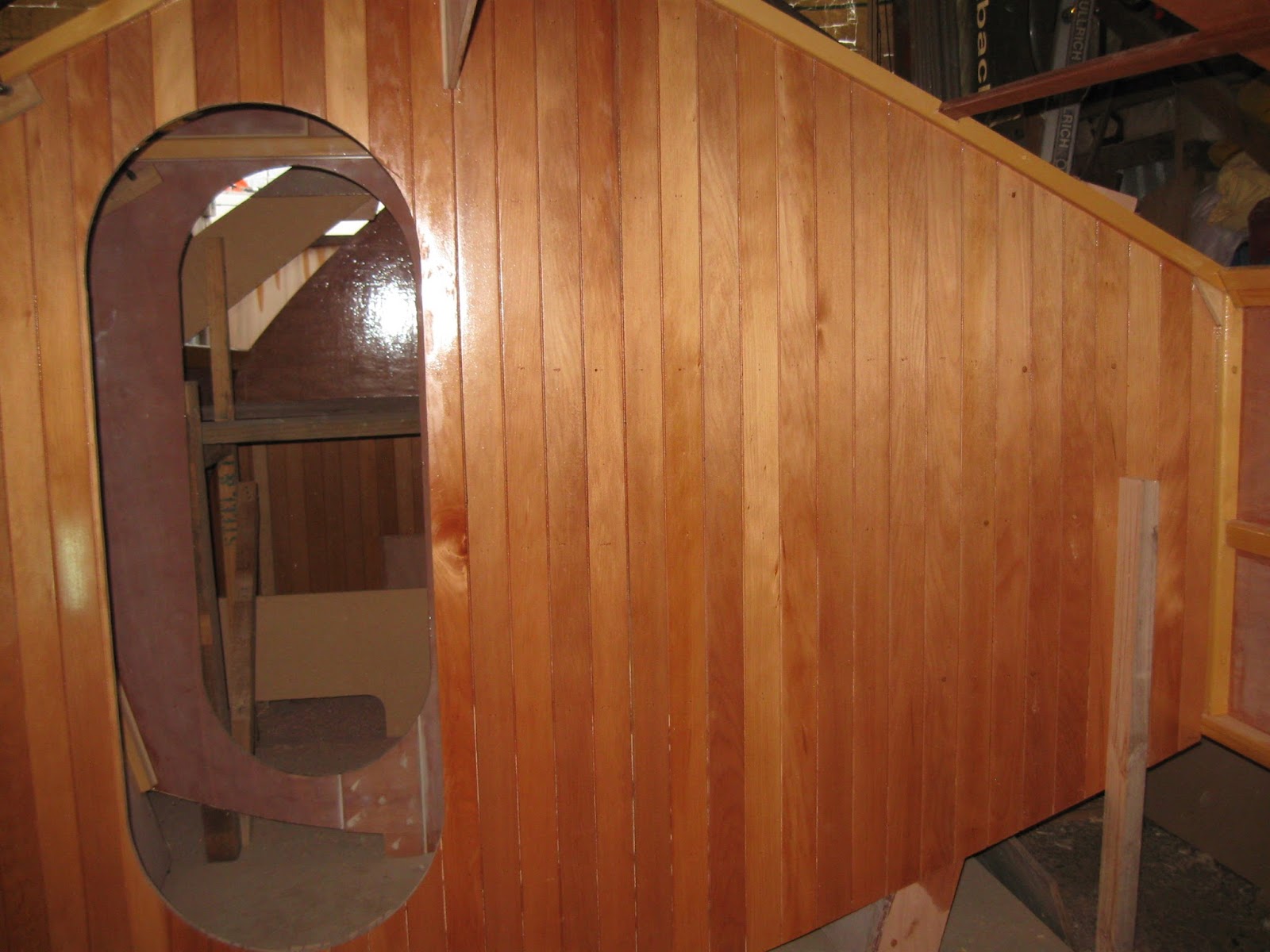
This is the photo of the forward end of the sleeping cabin.  I love the appearance of the kauri panelling. 

Shaping the final piece of plywood to fit at the bow.  I have bought a couple of Japanese pull saws and find them a lot easier to use than Western style.  They are so fast that I often use one instead of a jigsaw.  The one in the photo has a wonderfully flexible blade which also allows me to use it along curves, too.  When I use a jigsaw, I invariably have to plane the wood afterwards, but not with one of these hand saws.

This photo is taken with the camera lying back down on the strong back, looking up into the bow.  This will, of course, be the bottom when the boat is right side up.  I cleaned it up as well as I could, but once the boat is turned over, I shall pour epoxy thickened with high-density filler, into the very bottom of the boat to seal any voids and leave a smooth surface.  This very forward section of the bow will be empty.  Again, I shall probably fit an access hatch so that I can check that there are no issues over the years.

I had hoped to staple the two layers of 6mm ply together, but when I attempted to fit them, the twist of the bow was forcing the middle of the sheet away from the one below.  In the end, I had to screw from the middle diagonally up and down to get it flat.  The boat looks like a sieve and, very disappointingly, the screw points have gone through the coating on the inside.  Once she's turned over, it will have to be sanded and coated again.  However, there was not alternative solution and at least I'm sure the two sheets of ply are securely joined.

For once the gods smiled and the offcut from the full sheet fitted - just - the triangle left at the top.  By now I'd given up worrying about holes through the inside layer!

I am getting a lot better about using my power plane: here I'm making the scarph on the final sheet of 6 mm plywood.  The trouble with being an apprentice boatbuilder is by the time you are comfortable with a new skill, you don't need it any more!  (Although I dare say there will be one or two scarphs in the deck.)

The two final bow pieces: one precoated.  Precoating the plywood before putting the thickened epoxy on it might seem painfully pedantic, but the okoume (gaboon) plywood sometimes soaks up epoxy like blotting paper.  I'd rather waste some from drips than spend the rest of my life worrying that there are areas where there was insufficient glue to make a good bond.

And there we are: one completely closed-in hull.  I am very proud of what I have achieved and very pleased that it looks so symmetrical.  I just love that junk bow!

One of the reasons that I wanted to avoid screws was because all those holes need filling.  When the plywood is horizontal, it's not too much of an issue: you can make a fairly soft mix and force it in to the hole, but on a steep slope it's more difficult.  Too soft and it will drain out, too thick and it may not get to the bottom of the holes.  In the end I decided to use wooden pegs - trunells - and found large matches to be ideal.  As they are square in section, air can escape while you tap them in.  Dip in a thin slurry of epoxy and microfibres and stick them in the holes.  One swipe of my little saw knocks them off once the glue is cured.  I intended to recycle them, but the bits of glue still stuck on got in the way and even I can afford another box of matches!!

This is a photo as at yesterday.  You can see that all the overhanging ply has been trimmed off and I am longboarding the chines to get them sharp and fair.  Then they will be rounded over, ready for bi-axial glass tape, before the whole hull is faired.


In the meantime, the keel has been taking shape.  It consists of three layers of 50mm steel.  It is a special alloy, used for bridges and decorative steelwork, with additives to reduce corrosion.  Supposedly it is guaranteed for 50 years!  Long enough for me.  Murray Wilkinson, who owns Norsand, where I'm building SibLim, arranged to purchase the steel and then, even more obligingly, organised getting them cut to shape. 

The pieces of steel returned from being cut.  One of them has a distinct twist in the tail.

My friend Marcus wanted to make the pattern for the forward end of the keel, having very strong opinions as to how it should be shaped!  He thicknessed pine to the same depth as the steel, glued it up and then screwed the three layers together.  He then carefully shaped it all as one piece.  Once he was happy with it, it was unscrewed and handed to Kevin and Anton as a pattern.  It will also be used for me to help shape the deadwood along the bottom of the boat, to which the keel will be attached.

Anton picked up the steel and drove it around to the half round workshop where it was to be shaped.

It was tacked together and then Anton went to work shaping the bow, with Kevin checking that all the details were to his satisfaction.

Anton applied heat about a metre away from the after end of the twisted piece and cajoled it into place.  I hate working with metal, myself, but have a huge amount of admiration for people who can get big chunks of the stuff to do their bidding!

As you can see, the three pieces are now in perfect alignment.

The forward end was shaped carefully and Anton came back and marked again for a final finish.  More careful work with the grinder produced a smooth and fair leading edge.

A big hollow in the middle layer of the side had been worked over: a bit of filling with weld and a lot of grinding removed it altogether.   


29 May, 2016

Another Update on SibLim

I thought it's about time I posted a few more photos of progress.  As usual, there are some pics on the Junk Rig Association website.  I've had lots of visitors to the boat shed, who all make very kind comments about how quickly the boat is progressing.  I wish!  However, I never expected it to be a fast process and am pleased with what I've achieved.  My friend Rob, was absolutely invaluable in helping with the bilge panels - sheets of 12mm plywood are a handful for a small person to handle, but has had to leave to go back to Europe. he has been a great member of the SibLim Club.

Another visitor was John Welsford, back from a trip to Chile.  He came to check up on progress and brought me a wonderful present: a Bailey No 3 plane, which he rebuilt from parts.  This is narrower than most planes, which reduces its weight and, as John pointed out, fits my small hand more readily.  It's a delightful tool, but apparently they are not made any more.  Sad.  Many thanks, John.


While I'm working away, particularly when doing rather monotonous tasks like sanding and scraping, my mind is occupied with all sorts of thoughts. One is that I still haven't found a good name for this boat: SibLim (Small Is Beautiful, Less Is More) is a great name for the design, but isn't what I want for my (I hope) beautiful boat.  I'm  afraid I'm a bit of a romantic when it comes to boat names, and don't really like 'clever' ones, or puns - unless they are particularly subtle.  I don't want to call her after an animal again; nor do I want a girl's name, nor a star, nor a character from mythology.  It's all very difficult.

Below is a photo progress report:


With the temporary bulkhead removed, I can see the saloon panelling.

The scarphs land where they land, although it would be nice if they ended up on the bulkhead!


Additional framing around the bilgeboard panels.  This area will be sealed off, so I need to ensure that all the wood is thoroughly coated.  I will undoubtedly fit an access hatch, however, so that I can be sure there is nothing untoward going on.


I'm rather pleased with this scarph!


09 April, 2016

SibLim update


Every week, I try to post new photographs in my 'albums' on the Junk Rig Association's website. The outfit that hosts our site seems to keep moving the goal posts and what works one month, doesn't work the next.  The last few times I've uploaded photos to said albums, they've appeared in a totally random fashion.  One of my fellow members has suggested a way round this, but the whole thing takes forever, anyway, and I'm simply not prepared to delete all the photos and reload them.  Life is too short - especially when you are building a boat!  So for those of you who have tried to follow progress via the JRA, my apologies.

I didn't write about the wonderful Russell Boating Club's Tall Ships Regatta, that has also become the major junket for the NZ 'chapter' of the JRA.  Suffice it to say that it was excellent.  I only attended for a couple of days - being a busy boatbuilder - and the weather on the evening that I arrived was dire, but I enjoyed the whole event tremendously.  The bad weather had prevented our newest member of the fleet, Blondie from sailing up there (I hope to have some photos of her to show you some time), and Fantail's new owner (did I mention that I'd sold her?) had yet to take her over; neither La Chica nor Shoestring could make it, but we had quite a fleet for all that: Arcadian and Footprints from NZ, Tystie and Zebedee, who despite wearing the red ensign are almost Kiwi boats and Lakatao and Grand PHA from France, each on an extended voyage.  The latter I've already mentioned - Bertrand is a member of the SibLim Club - but I fell madly in love with Lakatao, which, while a Western design (Le Forrestiere) has many characteristics of a Chinese junk:


Her owners, Bruno and Elise are wonderful people and there is always laughter on board.  I found her incredibly inspirational for my own build, although I will never attain the craftsmanship of Bruno.

Back to Whangarei and my boatbuilding.  Because not everyone will want to follow my JRA links, I thought I'd just post a few photos here, so that anyone interested can follow my (glacial) progress.  The good news is that the money is holding out and I always knew that this project would take a long time, regardless of the other people who reckoned I should be able to 'knock it over' in a year.  I'm really enjoying the process, and that's the main thing.


At the end of December, the Icebreakers came along and fitted the skegs, thus earning membership of the SibLim Club.


Because of the junk bow, which is flat rather than pointy, the planking is put on starting with the bottom and I got into this, early in January.  Aft, I could use 12 mm plywood, but forward, where the bottom rolls into the bow, I had to use 6 mm because of the extreme curve.  On this photo a piece is laid out, ready to fit.


Before any further planking could be done, however, it was necessary to install longitudinals: a chine log, stringer and sheer clamp on each side.  These were laminated where necessary, in order to bend the wood to the curves of the hull.  The Alaskan Yellow Cedar that I buy comes in lengths of around 4 m, so once these were sawn and planed, they had to be scarphed together, as in the photo above.   WEST epoxy is my glue of choice, largely because I know it and can anticipate how it works.  I've tried other brands in the past but never got on with them as well. A lot of February was spent joining and fitting all these pieces of wood.


Come March and planking was in sight, but first I had to fit the sheer clamps.  SibLim is going to have davits and David designed them to be part of the main structure of the boat, running out from the sheer clamp.  I felt that these needed to be made from hardwood, rather than Alaskan yellow cedar and my friend, Marcus, contributed a variety of boards that he had stored away.  They varied from iroko to purpleheart.  I would be almost tempted to varnish them, just for their interesting colours!


So here we are in April, and the boat is starting to take shape.  It's really exciting to see what she looks like.  My little camera has quite a wide angle lens, which somewhat distorts the appearance of the hull.  In fact it's rather less beamy aft than it looks in this photo: indeed it's rather 'cod's head, mackerel tail' in appearance, which I very much like.

I never thought I'd find myself building another boat.  I most certainly never thought I'd find myself building another boat on my own, although to be perfectly honest, without good friends lending me a hand at certain critical moments, I don't think I could.  However, in essence I'm building this boat by myself and I have to say it's an incredibly satisfying process.  I'm not a clever woodworker: indeed I'm barely competent, but thanks to wonderful epoxy (yes, I know it's very toxic), good advice and the tendency of 12 mm plywood to fair out any wobbles, my boat seems to be pretty sound so far.  Because I know I will remember every bodge, every short cut, every 'she'll be right' moment, I am doing the best work I can and, thus far, I think I will be able to trust it.  Oddly enough, my greatest (irrational) concern is that there are no fastenings.  Badger had no fastenings and relied entirely on glue, and to the best of my knowledge and belief is still in one piece, so I'm not sure where this worry comes from.  I can actually see myself, one dark night, rushing round with drill and screws, shoving in fastenings left, right and centre, just before I put the glass and epoxy on the hull!

14 December, 2015

The SibLim Club


As you can imagine, building a boat is a pretty time-consuming operation, so that I don't have much opportunity for blogging.  However, anyone who is interested can follow progress on the Junk Rig Association website.  Progress is not particularly fast, but is extremely enjoyable.

One of the very rewarding and rather unexpected aspects of this build, is how many people want to get involved in one way or another.  It really seems to have caught their imagination and I enjoy how people want to share in the progress of SibLim.  First of all, of course, was David Tyler, who was inspired by my ideas to create a wonderful design to my criteria.  Then came Marcus, who not only let me take over his shed, but has allowed me to make use of his machine tools, none of which I could have afforded to buy. Because he is so sensitised to epoxy, at this stage he can offer very little in the way of hands-on work, but his advice (he's a professional boatbuilder) and insights are invaluable, and he helps out in many other ways.

A week ago, the amazing Grand Pha sailed into the Hatea River and anchored off Norsand Boatyard, where I'm building SibLim.  In short order, Bertrand was changed into his old clothes and had taken on the exacting task of notching bulkheads for the chine log. 


At this time I decided that we now have quite a cohort, and so The SibLim Club was founded and now had three members.

A couple of days ago, I had a visit from my friend, the designer John Welsford, who is also very interested in the project - in spite of not having designed the boat!

He arrived with delicious bread and cheese (relieving me of the necessity of preparing lunch, and, having given me a (much-needed) lesson in how to handle a chisel became the fourth member of the Club.  I dare say I shall have to design and make burgees to give to all members at the end of the build!

I sometimes worry that I've bitten off more than I can chew, taking on this task: the fact that friends are there to help and encourage me makes me feel less daunted and more confident about the undertaking.  Thanks to the SibLim Club, I now don't think I'll ever be at a loss when an extra pair of hands is required, or I am in need of some sound advice.


03 November, 2015

Why Fantail won't be at this year's Tall Ships Regatta


A couple of days ago, this flyer came in the post:

For all the junkies in NZ, the Tall Ships Regatta has become part of our life and is our major junket.  It's the greatest fun and I'd make a huge effort not to miss it, but this year, Fantail won't be taking part.  Why?  Because in a moment of madness, I've decided to build myself a replacement boat.  It's a long story, and it will take far too long for me to write it all up here, but it's largely to do with shoal draught, simplicity and and abiding love of wooden boats.  The whole saga can be read here, on the Junk Rig Association website.

Suffice it to say, that she will be 26 ft long, shoal draught and, of course, junk rigged.


My friend David Tyler and I have combined forces on the design: he's done the clever bits on the computer and I have told him what I want and how I want it.  It's taken some thrashing out at times, but I'm very happy with what we've come up with.


David sailed down from Canada, in August, to help me get the project started.  After a lot more debating, we sorted out the details and then built a model to help finalise dimensions.  We are building the boat for me, so instead of postulating a crew of three or four 6ft people, we are working around one, 5ft 1in woman.  This has meant that some things, such as the cockpit, are non-standard.


I have made my photos on the JRA site available to non members, so if you want to see more, have a look here.

Building a boat is a very full-time job, especially with all the other chores that have to be carried out on a daily basis, so I won't get much time to post on this blog.

And of course, it means that poor little Fantail will need a new home.  Anyone with NZ$23,000 in their pocket who would like my lovely little floating home, please contact me!

06 September, 2015

'Mariposa' needs to go sailing!

My last post was about the difficulty of finding a junk-rigged boat when you wnat one.  This one is about the fact that there is a beautiful little Contessa 26 looking for a home.  She has been owned for short periods of time by several people in the recent past.  One decided that buying a boat in the UK when he lived in NZ was perhaps not the wisest of decisions.  The second one did heaps of good work on the boat, having found some structural defects; she is now apparently in great shape and probably better than new.  He was about ready to do the finishing touches when he was offered work now in China.  The most recent owner finished off all the little jobs needed to get the boat sailing and then realised that his money wasn't going to go as far as he hoped and that getting work in Europe was easier said than done, so had to go back home to Oz to earn some more money.  Poor wee boat - aspirational and competent owners, but no-one to take her sailing.

Of course, at 26ft, she isn't even considered 'entry level', for most people, and without an inboard engine, she is dismissed out of hand by nearly everyone.  But I keep hearing about young, adventurous people desperate for an opportunity to Achieve Something.  For £5,500 someone can buy an adventure ready to go: put some food on board, fill up the water, pull up the sail and there you are.  Come on - there must be somebody out there who will grab this opportunity!

29 June, 2015

Where can I buy a junk-rigged boat?

I recently had a comment from someone called James, in USA.  He asked "Where do I start looking for a small boat that is junk-rigged in the U.S.? Have searched the Internet and have found only one boat in the U.S. And it was 36'."

This reminded me of something that I've heard said so many times by people debating re-rigging their existing boat with junk rig.  "What happens if I want to sell the boat?  Won't putting a junk rig on it make it more difficult?"

My usual response is to ask them why they are fitting the junk rig in the first place and generally they say because they couldn't find a boat already converted that would suit them.  Well, doesn't that answer the question for them?  There are lots of people looking for junk-rigged boats and there aren't many for sale.  Of course, if you happen to be in a country with a very restricted market, with a boat that is unlikely to be easy to sell anyway, having a junk rig may not necessarily swing the deal, but most of the people I know who have wanted to sell a junk-rigged boat have moved them along pretty quickly.

And to James, and other people who would like to buy a junk-rigged boat, I recommend you visiting the Junk Rig Association website, where there is a Swop, Sell or Buy forum that members use to list (and look for) boats.  And if you are thinking you'd like to buy a boat to sail distant climes, why not make it easy for yourself and buy one that's overseas to start with?!


Just think of the joy of owning something as delightful as one of these:


19 April, 2015

A Better Choice


To those who aren't used to boats, it might seem odd to the point of unpleasant, that when two or more boat owners get together, sooner or later they start talking about toilets.  But one of the big differences between living on a boat and living in a house, is that on a boat, you are far more closely concerned with the day-to-day realities that most people ashore completely ignore.  For them it's a case of turn on a tap and out comes water: another tap produces hot water!  You pull a plug and the water vanishes.  You flush a toilet and suddenly it is filled with clean water.  On a boat, however, none of this happens automatically.  Those of us who like to keep things simple manually pump water from a tank; heat it in a kettle; possibly pump it out of the sink and as for the toilet ...

For many years the norm has been to have a marine toilet that used seawater to flush out the contents of the bowl directly over the side.  There is no real objection to this: your e.coli apparently isn't that fond of salt water and doesn't last long.  Most sailors have experienced the sight of a shoal of fish rushing to the outlet and busily feeding, so you are obviously not disposing of noxious waste.  However, where you have a lot of boats gathered together there are reasons to worry about this arrangement.  For a start many marinas and inner harbours have a lot of fresh water coming into them.  This often floats over the salt water and is a fine place for you e.coli to breed.  If there is little or no flow of water, all the stuff pumped out will sink to the bottom of the harbour and there will probably be too much of it for the local flora and fauna to deal with.  In addition, if you are anchored in a popular spot, you don't want to pump out your toilet in an area where people are swimming.  The way round this is a holding tank, which you empty at a dedicated place in a marina or yacht harbour, or which you take out to sea and empty away from beaches, anchorages etc.

But sea toilets themselves are not without their issues.  In order for them to work effectively, they need to be able to pump in plenty of sea water, but all too often these pumps leak.  Not a lot, but a little water in an otherwise dry boat goes a long way, and the salt means that it's always damp in the area.  In addition, there are often valves to turn on and off, which non-sailors find disconcerting to downright worrying.  The most effective of the marine toilets I've dealt with is the Lavac, which only requires one to shut the lid and then pump, following simple instructions displayed on the bulkhead.  But even this paragon requires that you have two holes through the boat in order for it to work.  I happen to have a prejudice about holes under the waterline.  They have to be protected by a skin fitting that allows you to seal off the hole should the pipe leading to them fracture for some reason.  In theory, this could happen at any time and ideally one would shut all these sea-cocks off every time one leaves the boat.  Most people don't of course, because they fail very rarely.  But I know of more than one boat that has been lost because something failed between the hole and whatever the pipe led to.  In an ideal world, I wouldn't have holes under the waterline.

One can live with these niggles and worries, and most boats are bought with a sea toilet already fitted and the owners live with them.  When I bought Fantail she had a standard marine toilet, and a very indifferent holding tank.  One of my first jobs was to replace this with something a bit better and by and large things were OK.  However, the pump always dribbled sea water with the result that black mould would start growing the moment I turned my back.  I was getting increasingly irritated with this, but what finally destroyed any empathy I had for this system, was as a result from my moving from the cold waters of Tasman Bay to the warm waters of Northland.  Apparently the long, dark, inlet pipe was an ideal environment for something (I'm not sure what) to grow very happily.  But whatever it was, it liked a certain level of salt water, no more and no less, so when I stayed in a river for a while, it would grow and flourish, only to die when I went back to sea.  Then its salt water equivalent would grow and flourish only to die when I went back into a river.  How do I know?  Because each time I changed my environment, a couple of days later, the water coming into the heads would stink of sulphur and this appalling stench would last for a day or so, until all the dead matter was flushed through.  I got to the stage of dreading the change in water salinity.

I used to live with a Porta Potti, but they are heavy when full, and I didn't really relish the thought of struggling with one through the very narrow passageway into my heads compartment.  I decided to try out a composting toilet: a lot of friends have them and all spoke very positively about them.  I thought of making one, but realised that they need to be quite carefully set up for the female anatomy and I didn't really want to make one only to find it didn't quite work.  So in the end, I cashed in my savings and bought a C-Head.  These are made on a one-off basis by a chap called Sandy Graves in Florida.  It's not strictly correct to call them composting toilets: they are in fact, desiccators and to that end solids and liquids are separated.

Sandy has a variety of shapes and sizes and after we'd emailed back and forth, I decided which I wanted and it duly arrived.  It took me a while to get used to it: the dried coir bricks had to be reconstituted with water, and ended up too wet to do their job properly.  I then tried wood shavings, but found that the hardwood didn't do a very good job of absorbing moisture either.  I was seriously contemplating installing a fan to assist, although this was something I very much wished to avoid.  However, a bag of softwood shavings worked like a charm and instead of adding more medium almost every time I used the toilet, I found it stayed dry for ages.  Now that I have found the ideal medium, I am delighted with my 'composting' heads.  It is easy to empty out at sea; alternatively, you can put the solid waste into a stout bin liner, pour over half a cup of bleach and dump it ashore.  I much prefer to wait until I'm outside the 'no dumping' limits.  The website has several different ideas as to what you can use for a medium: I guess it's essentially trial and error until you find what works for you. The bottle can simply be emptied over the side, rinsed out and put back in place.

So that's two fewer holes under my boat; a toilet compartment that is easy to keep nice and clean and no smell.  I can only recommend this as a much better alternative to a conventional marine toilet.

12 April, 2015

Another junket - and Tall Ships Regatta


With a New Year comes the anticipation of another Russell Boating Club Tall Ships Regatta, and once again a number of junkies had decided to combine it with a junket.

Arcadian and Fantail briefly shared an anchorage, but a couple of days later, we came across Zebedee; Alan, Pauline and I agreed to sail up Te Puna anchor to Crowles Bay and as we sailed through Kent Passage, there was Arcadian coming in from the outer bay.  We caught them up and then had a great sail up the inlet with a splendid chance for a photo op before coming in to anchor.

Arcadian is the party boat, par excellence and the noise was soon up to acceptable levels on board.  David and Rosemary always give us the impression than they like nothing better than to have a heap of noisy, hungry people come on board, eat and drink and then go home leaving them with all the washing up.  Each boat always contributes something to the feast, and if nothing else, at least we take our pans home, but I always feel a bit guilty as we row away, leaving their home in a shambles!

For the next few days, each boat pottered around the area before meeting again for the Big Event, by which time we had been joined by La Chica and Pugwash

Readers of this blog will already have encountered Pugwash in his orange cover, oars poking out and looking like some sort of strange insect paddling across the water.  However, Marcus was dissatisfied with this arrangement - the cover leaked, which not only makes it a bit wet when sailing, but allows the rain into the interior, should he wish to spend the night on board.  So he had spent some time turning Pugwash into a much more sea-going boat.

The wee boat looked inconceivably cute, with its windows and - amazingly - a self-steering gear.  And if the idea of a self-steering gear on an 8ft 6in boat seems unlikely, perhaps the most astonishing thing about it is the fact that it works very well!

When the day of the race arrived, Marcus had difficulties getting away from the dinghy dock: everyone wanted to know all about the boat and the conversion.  They held their own in the fleet, but most people simply couldn't believe their eyes:  from the stern, Pugwash looks like a miniature Endeavour 

and the crews of the passing boats goggled at this strange apparition, and the sight of Marcus calmly drinking his home brew while his tiny ship sailed herself to windward!  They caught everybody's attention and even ended up in prime place in the local paper's coverage of the event.

In the meantime, the rest of the fleet divided into two races.  La Chica and Zebedee were obviously going to be a close-run combination.  Paul had redesigned and re-built his rudder and reckoned he would wipe the smile off Alan's face, but it was an extraordinarily close-run race and they crossed the finish line within moments of one another, La Chica just ahead.  Meanwhile, they were showing some of the other boats just what a well-rigged and well-sailed junk-rigged boat can achieve.

Roger had left Shoestring in Auckland where she is undergoing rig alterations (yet to be finalised), but took this magnificent photograph of Zebedee and La Chica jousting for position at the start line.  If you want to see some more splendid photos, please look at Roger's album here.

Arcadian, Zebedee and La Chica all counted as Tall Ships, whereas little Fantail was in another class (and poor Pugwash) was too small to be entered.  But Arcadian and Fantail ended up in their own race, which Arcadian finally won on the homeward, down wind leg, where her long waterline let her walk away from us.   

Fantail meanwhile had had a less than happy day, for some reason unable to find her rhythm in the inconstant breeze which seemed to come round to the nose every time I hoped it might just free us.  The most disappointing aspect of this was that I had a friend on board, a sceptic about junk rig, whom I'd hoped to impress.  But it was not to be.  However, we all enjoyed the fine party after the race and I think both Alan and Paul were very proud to realise how well they had done in the Tall Ships fleet, where they were placed 9th and 10th on handicap.  Fantail's only consolation was that although she was last to cross the line, she did cross the line before the final gun, unlike a lot of the competitors who had long since given up.

The Regatta might be over, but the junket carried on and a couple of days later, Zebedee, Pugwash and Fantail had a splendid sail in company together: Zebedee and Pugwash looked quite wonderful as they sailed side by side.

But Pauline and Marcus had to head back to work, so we all went our separate ways, with another splendid junket under our belts.  In truth, I'm not sure that any of us had the stamina for yet another wonderful party aboard Arcadian.  But we were all very pleased to have had no fewer than 5 junk-rigged boats at the regatta: the wonderful Christine Hall even let us have a class of our own for first across the line - won by La Chica.

15 January, 2015

The Year Comes To An End


(Please excuse the formatting: I tried for hours, but Blogger just isn't cooperating with me today.)
 
Well, eventually the weather did improve sufficiently for me to escape North. On the 19th December, I sailed up to Tutukaka. Sailing into the rather confined harbour of, with the wind from astern, and trying to anchor ‘further in’ to be away from wakes and the swell, I could successively reef the sail to approach my chosen anchorage at a sensible speed.  At the end I sheeted hard in – easy to do with so little sail – and rounded up, dropping the last three panels of sail.  These are unsheeted, so there was my sail, neatly stowed, while I went forward to drop the hook.

Tutukaka was pretty rolly in the left over swell – we’ve had a lot of E recently, but not as bad as it has been. Next day, Ladybug and Melody sailed in and I was invited over for dinner on Melody. I left bright and early on the following day for for Mimiwhangata and as I ghosted out the others followed suit.  


Photo credit: Chris Bennett 


It was a run up the coast.  Melody tacked down wind and Ladybug poled out his sail, he said in order to try and catch me up because normally he can’t be bothered.  But he didn’t catch me until the end of the passage, when we were both close-hauled.  But at 34ft against 26ft, so he should, and even then he didn’t outpoint me. The conditions were perfect for Fantail to show off.  We sailed in to the anchorage together and he rolled up a lot of his jib to make it easier to tack.  Then he rolled it up for his final approach to anchor.  I was waiting for him, tacking back and forth and finally reefing, to let him anchor first.  He spent 10 minutes sorting out the mainsail and covering it while I drank my beer.  The second boat came in about 15 minutes later and it took them several minutes to sort out their cutter rig and finally to come in to anchor under mainsail alone.

They came over for dinner, and we had another pleasant evening. They left the next day for the Cavalli Is. 


and in the afternoon, I ambled over to Whangaruru for Christmas. It was a lovely, quiet spot and I thoroughly enjoyed myself cooking good food and relaxing with a book I’d bought as a treat. I even had a couple of presents to open!! 


I took a couple out for a sail, while I was there. They were very impressed with the ease of tacking and the uncluttered deck.  I think they liked running the most, because they said that they really hate fooling around with poles, especially at night.

I left a few days later and sailed down the harbour and round Cape Brett into the Bay of Islands. The almost non-existent wind of the morning had turned into a great F3 and everyone else was motoring downwind with an onshore swell, I had a fine sail. In fact if anyone wants to know what the greatest advantage of junk rig is over anything else, I reckon the last week or two's sailing has told me what it is: it's fun!  And the reason it's fun is because it's so easy.

Coming to the end of the day, I sailed through the Waewaetorea Passage at the W end of Urupukapuka I.  Ahead of me was the only other boat sailing in the Bay: he gybed three times, which would have been pretty scary in that narrow passage with the swell-driven waves breaking quite dramatically on either side.  I sailed ridiculously by the lee (I was showing off and could have gybed) and then headed up for my anchorage.  He dropped his sails and motored in: I had the prettiest little beat between the shore and a heap of anchored boats (four tacks in 200 yards) and dropped sail and anchor in about 15 seconds.

The bay was very crowded, with all sorts of vessels at anchor, but it was actually nice to be among people who were busy enjoying their boats.  


Much better than seeing them all sitting in marinas. Close to the beach there were two large rafts of launches. I reckoned that we were in for a noisy night, 


but I couldn’t have been more wrong.  Either the parties ended early, or everyone went below because by 10 o’clock all was quiet.  No buzzing outboards taking people back home, either.

In the morning, as I went to shorten in my anchor, I could see it clearly, lying on the clean sand bottom.  The water was crystal clear: we could have been in the Caribbean, especially with the sun already hot on my back.


Leaving Otaio Bay, I raised the top 3 or 4 panels of sail.  The breeze was very light, so I didn't make off the sheet.  I’d shortened up the chain and set the self-steering gear to take me out on the port tack.  Waiting until we went through the wind, I hauled up the last few feet of chain, catted the anchor and went back to raise the rest of the sail, freeing the helm so that I could nudge the tiller with my foot as we sailed between some anchored boats.  Two people were watching as I raised the rest of the sail and hauled in the luff hauling parrel.  We were now on a dead run, so I could let the sheet haul out to its stopper knot.  Leaving the helm I nonchalantly went below to fetch a cup of tea, in the hope that they were suitably astonished at the ease of it all.

Later, when the wind had picked up, we were romping along and overtook a 38 footer motoring downwind, probably because he uses hanked-on headsails and they weren’t hanked on.  It must be quite an effort to get the bag on deck, hank on the sail, raise it and sheet it in with only a few miles to go.  I sailed around an interesting little barque at anchor before beating up into my chosen anchorage, but foolishly tried to photograph it with my phone, so it didn’t come out.  I gradually reefed as I came in to anchor, so that I could ‘park’ exactly where I wanted. 

Here I stayed until New Year’s Day.  As the New Year came in, I broke out a wee bottle of bubbly and drank a toast to my little ship as the fireworks exploded over Waitangi.  2014 had been another wonderful year.

16 December, 2014

A fine start to the season


I decided to spend the winter with Fantail hauled out this year.  There were a variety of reasons for this: some of them worked out, some didn't, but it saved me getting even more fouling on the boat, being bullied by the harbour master and worrying about dragging my anchor.  (Not, touch wood, that Fantail has yet done that.)

As usual, in spite of being out for so long, there were outstanding jobs uncompleted and a mad rush to get everything done so that we could go back in.  One of the jobs I did do, was to take the mast out and change the masthead fitting.  You may recall that I had a half inch bolt sheer off a few months ago.  Well, now all the bolts have been removed and instead of metal at the masthead, I have heavy a webbing strap, securely sewn, around the top, with loops for the shackles sewn to it.  (Yes, I know, stainless steel shackles, but a girl lives in hope!)


I dressed the mast once more and then rang up the friendly and obliging Bruce Yovich to come along and pop the mast back in.  Bruce has a miniature crane which is just perfect for this job: it's the real McCoy with a jib that extend to three times its telescoped length, but costs a fraction of the full-sized brute.  Anyway, along comes Bruce and 15 minutes later the mast is stepped.  I took extra pleasure in this speed and simplicity: a nearby ketch, restepping his masts, had had a crane in for 3 hours the previous day!

On 25th November, the great team at Norsand Boatyard, who had kindly tolerated me being on my boat all winter, carefully put Fantail back in to her proper element.  They have a cunningly designed trailer that gets under the boat's cradle, trundles her down to the slipway and then slowly slides her back in to the water.  It's all a lot less nerve-wracking than watching one's pride and joy swinging through the air in the slings of a travel lift.


It was great to be back in the water and ready to go.  I pottered around with a few more jobs waiting for the SW winds to go away and on a fine December day, set off down the harbour to catch up with Zebedee at the Hen and Chickens - a group of islands about 7 miles from the entrance to Whangarei Harbour.  Well, that was the plan.  We left Parua Bay about nine o'clock and whizzed out with a strong ebb tide under us.  The forecast NW wind was in fact NE, once we got out of the lee of the land, but we could lay the islands without too much problem.  The chart showed a couple of possible anchorages, possible only in northerly conditions, after several days of light winds so that there was no swell running.  It is, as we all know, a naughty world, but I've always felt that I could rely on charts produced under the auspices of Her Majesty's New Zealand Navy; however on this occasion I was disappointed.  Sailing in confidently to anchor in somewhere under 8 metres, I was more than a little surprised to see my (resolutely Imperial) echo sounder reading 36 ft.  I dropped the sail, which seemed reluctant to come down - just what I needed - and motored further in.  And further and further.  By this time we were less than 100m off the beach with rocks all round, a gusty wind and still with over 30 ft on the echo sounder.  I don't like anchoring in such deep water and I couldn't imagine Alan being happy to sail into this constrained place and - worse - having to sail out of it again, especially with the high ground to the north of me making the wind very fluky.  So, somewhat reluctantly, I abandoned the attempt.


I sent Alan a text by cellphone and he confirmed my guess that he'd prefer not to try it either, so I hauled the sail back up and sailed back, the wind having disobligingly shifted to the NW, so that once again I was pretty much close hauled.  We planned to spend the night in Smugglers Bay, well-placed to take tomorrow's N wind down to Kawau I and the Hauraki Gulf for a little cruise in company.  Zebedee got there a few minutes before me, having sailed down from Whangaruru, and he and Pauline came over for dinner.

The wind in Smugglers had died away as I was sailing in, so I'd come in under power.  Again, the sail seemed reluctant to come down.  It had the horrible clack-clack-clack sensation that I've experienced before: it means that the sheave is badly damaged.  I didn't wish to believe this: surely there was another explanation?

Next morning dawned clear, with a light N breeze.  Perfect to get away.  The forecast was for the wind to strengthen considerably later, but if I left straight away, I should be under the lee of Kawau I before it filled in.  I shortened the anchor chain and raised the top few panels of the sail to sail out.  Once the anchor was in its roller, I went back to the cockpit to raise more sail.  This time I knew I wasn't mistaken: the sail refused to go up any further; indeed, I wondered if it would come down.  I sailed back, explained my predicament to Alan and then sadly set off back up Whangarei Harbour.  I had no spare blocks on board suitable for the job, so I'd have to buy some more.  And in the river, I had the chance of very calm conditions to go up the mast.

Back at anchor I ordered the blocks, which arrived the next day.  A Canadian cruising friend happened to be in the river, so he offered to haul me up the mast the following morning, when it should be calm.  All went according to plan; I managed to do the job at the top of the mast without succumbing to a panic attack - I absolutely loathe going up the mast - and came down before anyone went screaming past leaving a big wake, or the wind filled in.  I showed Chris the block: the sheave was absolutely shattered.  Obviously the sun had attacked the white plastic and made it brittle.  The odd thing was that last time I'd used it, it had seemed fine, and I'd have thought it would have been protected from the sun by the rope running over it.  I was glad I'd made the decision to replace both.


That afternoon I topped up my diesel - once I'd started heading up the harbour I'd motored as there was no way I could have beat up with only 3 panels of sail - and water, and was ready to leave.  That was nearly a week ago!  Since then we've had dreadful weather and I've been happy to be tucked up way up the harbour while gales and storms have blown around us.  More gales are forecast, followed by light winds and rain, rain, rain.  What's happened to summer?  I'll be lucky to be out of Whangarei for Christmas at this rate!


02 September, 2014

As soon as I arrived in New Zealand, I felt that I had come home, and this is probably why I have so little temptation to leave.  I can't say that I was ever looking for 'home', or at least not consciously: it's just one of those things.

Perhaps the true test of love is being able to see faults in the beloved, but still to accept it/her/him.  This applies to my feelings for NZ: I can see the faults, and with an election just around the corner, they are even more glaring than usual, but overall I am happy here.  And I can try to get involved in issues I care about, say my piece and vote for those who put the country and her inhabitants before the acquisition of personal financial gain.

I recently went to a concert by a ukulele trio who sum up all that I love about NZ: but better still, their music is quintessentially Kiwi.  You need to live here to understand some of it, but that is why it's so true.  Most of it is loving, but occasionally they voice their concerns, and when they do, they don't pull their punches.  See if you can get to hear some of it.  The Nukes are virtuoso instrumentalists - you never knew the humble uke could sound like this - inspired songwriters and brilliant performers.  They have made two albums and you can download a track, The Last Kauri from their most recent one, for free. 


28 August, 2014

Anchoring under sail


There has been a little bit on the JRA Website about anchoring under sail. My good friend Zan on Demara,  made a video, which concluded with me anchoring Fantail in Matauwhi Bay, last summer, under sail.  It looks amazingly easy in the video.  It is!  Another reason that junk rig is so good for single-handed sailors.  Here is the full video - I found that the clips I originally posted, didn't work.